Social Regionalism in the Global Economy
0
0
As an Amazon Associate and affiliate partner, Menrva Books earns from qualifying purchases. Learn more
Author Description
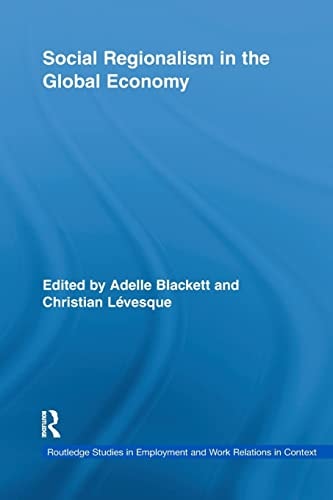
Regional trade agreements have expanded exponentially over the past decade, and have become a significant, if controversial, factor in the expanse of economic globalization. Social Regionalism in the Global Economy attempts to take a fresh, interdisciplinary approach to addressing labour regulation by drawing upon insights from industrial relations, comparative capitalism, and new governance schools of thought. It stands for the proposition that an interdisciplinary study of regional regulation holds the potential to offer a fuller account of social regionalism. Its focus is to consider how institutions and labour market actors reconstruct and renegotiate regulatory space in a changing economic environment characterized by regional impulses. It argues that there is a dynamic interplay between institutions and actors of social regulation. This interplay occurs at many levels. The book therefore maps both how actors shape institutions as well as how institutions shape social actors’ ability to affect regulatory processes.The editors bring together leading international specialists willing to move beyond textual analyses of regional agreements to offer alternative accounts of regional integration. The work emphasizes that institutional context and social actors at multiple governance levels are integral to the progressive construction and regulation of regional space. It further contributes to the literature by combining insights from overlooked regional entities in transition and developing countries with original analyses from the European Union and the NAFTA. These aims will be achieved by combining original research that is empirically grounded with theoretically informed analysis.
Menrva's Summary
THE THESIS
This book investigates how regional trade agreements and social actors interact to reconstruct labor regulation within the context of an expanding global economy. Editors Adelle Blackett and Christian Lévesque utilize an interdisciplinary framework, synthesizing perspectives from industrial relations, comparative capitalism, and new governance theory. The text argues that social regionalism is not merely a product of top-down agreements but a dynamic, multi-level process where institutions and social actors mutually shape regulatory outcomes.
THE SCOPE MAP
What You Will Find
- Comparative analysis of labor regulation across the European Union and NAFTA.
- Case studies focusing on regional entities in transition and developing economies.
- Theoretical frameworks integrating industrial relations and new governance schools of thought.
- Empirical research examining the interplay between institutional structures and social actors.
THE AUTHORITY PERSPECTIVE
Experts recognize this volume as a significant contribution to the study of international labor law and regional integration. Scholars frequently cite the work for its successful integration of empirical data with complex theoretical models regarding global economic governance.
Page Count:
366
Publication Date:
2010-01-01
Publisher:
Taylor & Francis Group
ISBN-10:
0203844831
ISBN-13:
9780203844830
Economics
Globalization
Labor Relations
Sociology
Regionalism