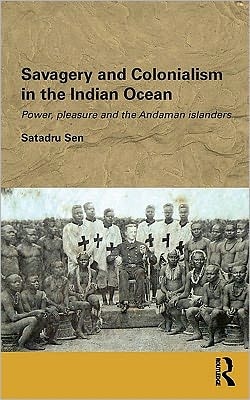
Savagery and Colonialism in the Indian Ocean: Power, Pleasure and the Andaman Islanders
0
0
As an Amazon Associate and affiliate partner, Menrva Books earns from qualifying purchases. Learn more
Author Description
This Book Examines The Social, Political And Ideological Dimensions Of The Encounter Between The Indigenous Inhabitants Of The Andaman Islands, British Colonizers And Indian Settlers In The Eighteenth And Nineteenth Centuries. The British-indian Penal Settlements In The Andaman Islands - Beginning Tentatively In 1789 And Renewed On A Larger Scale In 1858 - Represent An Extensive, Complex Experiment In The Management Of Populations Through Colonial Discourses Of Race, Criminality, Civilization, And Savagery. Focussing On The Ubiquitous Characterization Of The Andaman Islanders As 'savages', This Study Explores The Particular Relationship Between Savagery And The Practice Of Colonialism. Satadru Sen Examines Savagery And The Savage As Dynamic Components Of Colonialism In South Asia: Not Intellectual Abstractions With Clear And Fixed Meanings, But Politically 'alive' And Fiercely Contested Products Of The Colony. Illuminating And Historicizing The Processes By Which The Discourse Of Savagery Goes Through Multiple And Fundamental Shifts Between The Late Eighteenth And Late Nineteenth Centuries, He Shows The Links And Breaks Between These Shifts And Changing Ideas Of Race, Adulthood And Masculinity In The Andamans, British India, Britain And In The Wider Empire. He Also Highlights The Implications Of These Changes For The 'savages' Themselves. At The Broadest Level, This Book Re-examines The Relationship Between The Modern And The Primitive In A Colonial World--provided By Publisher.
Menrva's Summary
THE THESIS
This book investigates how the discourse of 'savagery' functioned as a dynamic, politically contested tool of colonial management within the British-Indian penal settlements of the Andaman Islands. Satadru Sen, a historian specializing in colonial South Asia, utilizes archival records and colonial administrative documents to analyze the intersection of race, criminality, and civilization. He argues that the characterization of the Andamanese was not a static intellectual abstraction but a shifting construct that evolved alongside changing imperial concepts of masculinity, adulthood, and medicine. By examining these shifts, the author reveals how colonial power structures were maintained and justified through the systematic categorization of indigenous populations.
THE SCOPE MAP
What You Will Find
- Historical analysis of British-Indian penal settlements in the Andaman Islands from 1789 to the late nineteenth century.
- Examination of the evolving colonial discourse surrounding race, criminality, and the 'savage' identity.
- Case studies on the impact of colonial medicine, labor practices, and counterinsurgency on the Andamanese population.
- Exploration of the intersection between colonial power, eroticization of the native body, and the construction of imperial masculinity.
THE AUTHORITY PERSPECTIVE
Scholars in the field of post-colonial studies and South Asian history frequently cite this work for its rigorous interrogation of how colonial ideologies were physically and socially imposed on indigenous groups. Readers often note the academic density of the prose, which provides a detailed, critical look at the mechanisms of imperial control and the resulting consequences for the Andamanese people.
Page Count:
288
Publication Date:
2010-01-01
Publisher:
Routledge
ISBN-10:
0203863089
ISBN-13:
9780203863084
History
Anthropology
Racism
Pleasure
Colonialism
Race Studies
Sociology
Colonization
Colonies
British
Race Relations
Power Social sciences
Community Tags
Similar Books