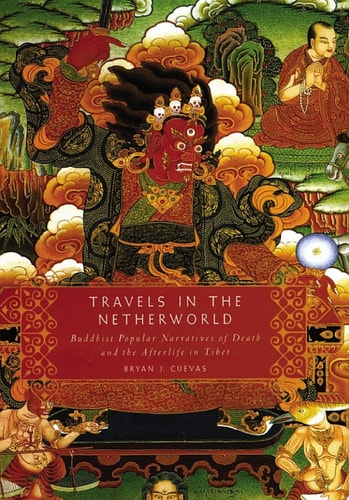
Travels in the Netherworld: Buddhist Popular Narratives of Death and the Afterlife in Tibet
0
0
As an Amazon Associate and affiliate partner, Menrva Books earns from qualifying purchases. Learn more
Author Description
In Travels in the Netherworld, Bryan J. Cuevas examines a fascinating but little-known genre of Tibetan narrative literature about the délok, ordinary men and women who claim to have died, traveled through hell, and then returned from the afterlife. These narratives enjoy audiences ranging from the most sophisticated monastic scholars to pious townsfolk, villagers, and nomads. Their accounts emphasize the universal Buddhist principles of impermanence and worldly suffering, the fluctuations of karma, and the feasibility of obtaining a favorable rebirth through virtue and merit. Providing a clear, detailed analysis of four vivid return-from-death tales, including the stories of a Tibetan housewife, a lama, a young noble woman, and a Buddhist monk, Cuevas argues that these narratives express ideas about death and the afterlife that held wide currency among all classes of faithful Buddhists in Tibet.Relying on a diversity of traditional Tibetan sources, Buddhist canonical scriptures, scholastic textbooks, ritual and meditation manuals, and medical treatises, in addition to the délok works themselves, Cuevas surveys a broad range of popular Tibetan Buddhist ideas about death and dying. He explores beliefs about the vulnerability of the soul and its journey beyond death, karmic retribution and the terrors of hell, the nature of demons and demonic possession, ghosts, and reanimated corpses. Cuevas argues that these extraordinary accounts exhibit flexibility between social and religious categories that are conventionally polarized and concludes that, contrary to the accepted wisdom, such rigid divisions as elite and folk, monastic and lay religion are not sufficiently representative of traditional Tibetan Buddhism on the ground. This study offers innovative perspectives on popular religion in Tibet and fills a gap in an important field of Tibetan literature.
Menrva's Summary
THE THESIS
This work investigates the cultural and religious significance of the 'délok' narratives, which are accounts of individuals who claim to have died and returned from the Tibetan afterlife. Bryan J. Cuevas, a scholar of Tibetan religion, utilizes a multidisciplinary approach to analyze these accounts, drawing upon canonical scriptures, ritual manuals, and medical treatises. He argues that these narratives challenge the traditional academic binary between elite monastic religion and popular folk belief, demonstrating a shared understanding of death and karma across all levels of Tibetan society.
THE SCOPE MAP
What You Will Find
- Analysis of four primary 'délok' narratives featuring a housewife, a lama, a noblewoman, and a monk.
- Examination of Tibetan Buddhist concepts regarding karma, impermanence, and the mechanics of rebirth.
- Exploration of supernatural elements including demonic possession, ghosts, and the geography of hell.
- Integration of diverse source materials, from scholastic textbooks to oral traditions.
Scope Limits
- The study focuses specifically on the 'délok' genre and does not provide an exhaustive history of all Tibetan funerary rites.
- The analysis is limited to traditional Tibetan sources and does not incorporate contemporary psychological or near-death studies from Western perspectives.
THE AUTHORITY PERSPECTIVE
Scholars in the field of Tibetan studies recognize this text as a significant contribution to the understanding of popular religious practice and the blurring of monastic and lay boundaries. Readers frequently note the academic rigor of the prose and the author's ability to synthesize complex canonical doctrine with accessible folk narratives.
Page Count:
212
Publication Date:
2008-01-01
Publisher:
Oxford University Press
ISBN-10:
0190450894
ISBN-13:
9780190450892
Philosophy
Religion
Buddhism
Tibet China
Buddhism china
Folklore
Death & dying
Death
Buddhist
Cultural History
Community Tags
Similar Books