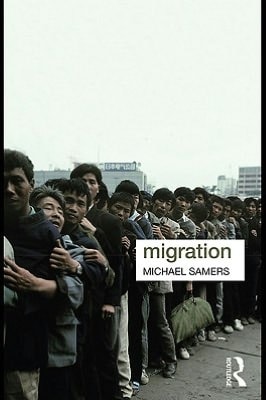
Migration
0
0
As an Amazon Associate and affiliate partner, Menrva Books earns from qualifying purchases. Learn more
Author Description
In the context of global security concerns, humanitarian crises and skill shortages migration and immigration have become central to economic, political and social debates at the beginning of the twenty-first century. And while migration and immigration have certainly not escaped the attention of social scientists, the study of both remains the most ‘under-serviced’ academic domain with respect to introductory texts. It is not surprising then that even fewer books have explored the contours of these social phenomena from an explicitly geographical perspective – in other words, in terms of ‘space’, ‘place’ and ‘scale’.Migration is an advanced, yet accessible, introduction to migration and immigration in a global context. It offers a critical, multi-disciplinary approach to the subject, borrowing from human geography, political science, social anthropology and sociology. However, unlike other broad volumes on the subject, it emphasizes a theoretical and conceptual approach to the study of migration. Specifically, Migration adopts a unique geographical approach by employing spatial concepts such as place, scale and territory. Using these spatial concepts, the author argues that most studies of migration begin with either an undue emphasis on nation-states as a lens on migration or on the contrary rely on exaggerated notions of transnationalism. Migration neither neglects the importance of nation states nor the significance of transnationalism, but it focuses on how local contexts matter to migration. The book covers such topics as migration categories, the explanation of different forms of migration, migration and employment, the geopolitics of migration and immigration and citizenship, rights, and belonging.This text is not simply an encyclopaedic overview of migration theories, trends and facts; rather, it is designed to have lasting intellectual value by providing particular arguments in each theme-based chapter. While it advocates certain arguments, it is also clea
Menrva's Summary
THE THESIS
How can a geographical framework of space, place, and scale provide a more nuanced understanding of global migration than traditional nation-state or transnational models? Michael Samers, an academic specializing in human geography, utilizes a multi-disciplinary approach to challenge existing paradigms in migration studies. By integrating concepts from political science, sociology, and anthropology, the author argues that local contexts are essential to understanding the complexities of human movement, employment, and citizenship in the twenty-first century.
THE SCOPE MAP
What You Will Find
- Theoretical analysis of spatial concepts including territory, scale, and place.
- Critical examination of the intersection between migration, employment, and global labor markets.
- Discussion of the geopolitics surrounding citizenship, human rights, and social belonging.
- Comparative evaluation of nation-state-centric models versus transnational perspectives.
THE AUTHORITY PERSPECTIVE
Experts recognize this text as a significant contribution to the field for its departure from purely encyclopedic overviews in favor of a theoretically rigorous, argument-driven structure. Readers frequently note the academic density of the prose, which is intended for advanced students and scholars seeking a sophisticated geographical lens on migration.
Page Count:
392
Publication Date:
2010-01-01
Publisher:
Routledge
ISBN-10:
0203864298
ISBN-13:
9780203864296
Science
Sociology
Geography
Social Science
Anthropology
Spatial behavior
Migration Studies
Community Tags
Other Editions(3)


Similar Books









Reader Comments
Share Your Thoughts
No comments yet. Be the first to share your thoughts!