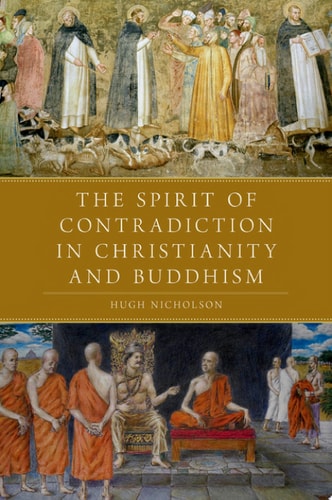
The Spirit of Contradiction in Christianity and Buddhism
0
0
As an Amazon Associate and affiliate partner, Menrva Books earns from qualifying purchases. Learn more
Author Description
The cognitive science of religion has shown that abstract religious concepts within many established religious traditions often fail to correspond to the beliefs of the vast majority of those religions' adherents. And yet, while the cognitive approach to religion has explained why these "theologically correct" doctrines have difficulty taking root in popular religious thought, it is largely silent on the question of how they developed in the first place. Hugh Nicholson aims to fill this gap by arguing that such doctrines can be understood as developing out of social identity processes.He focuses on the historical development of the Christian doctrine of Consubstantiality, the claim that the Son is of the same substance as the Father, and the Buddhist doctrine of No-self, the claim that the personality is reducible to its impersonal physical and psychological constituents. Both doctrines are maximally counterintuitive, in the sense that they violate the default expectations that human beings spontaneously make about the basic categories of things in the world. Nicholson argues that that these doctrines were each the products of intra- and inter-religious rivalry, in which one faction tried to get the upper hand over its ingroup rivals by maximizing the contrast with the dominant outgroup. Thus the "pro-Nicene" theologians of the fourth century developed the concept of Consubstantiality in the context of an effort to maximize, against their "Arian" rivals, the contrast with Christianity's archetypal "other," Judaism. Similarly, the No-self doctrine stemmed from an effort to maximize, against the so-called Personalist schools of Buddhism, the contrast with Brahmanical Hinduism with its doctrine of an unchanging and eternal self. In this way, Nicholson shows how religious traditions, to the extent that their development is driven by social identity processes, can back themselves into doctrinal positions that they must then retrospectively justify.
Menrva's Summary
THE THESIS
This book investigates how counterintuitive religious doctrines emerge and persist within established traditions by analyzing them as products of social identity processes and inter-group rivalry. Hugh Nicholson, a scholar of religion, utilizes a framework grounded in the cognitive science of religion to address the gap between abstract theological concepts and popular belief. He argues that doctrines like Christian Consubstantiality and Buddhist No-self were developed not merely as theological truths, but as strategic markers of identity intended to distinguish specific factions from their rivals.
THE SCOPE MAP
What You Will Find
- Analysis of the Christian doctrine of Consubstantiality in the fourth century.
- Examination of the Buddhist doctrine of No-self in relation to Personalist schools.
- Application of social identity theory to historical theological development.
- Comparative study of how intra-religious rivalry influences doctrinal evolution.
Scope Limits
- The text does not provide a comprehensive history of all Christian or Buddhist doctrines.
- It does not focus on the personal spiritual experiences of individual practitioners.
THE AUTHORITY PERSPECTIVE
Scholars in the field of religious studies recognize this work as a significant contribution to the cognitive science of religion by bridging the gap between social psychology and historical theology. Readers frequently note the academic density of the prose, which requires a foundational understanding of both historical theology and cognitive theory to fully appreciate the author's arguments.
Page Count:
344
Publication Date:
2016-03-01
Publisher:
Oxford University Press
ISBN-10:
0190455349
ISBN-13:
9780190455347
Religion
Philosophy
Theology
Sociology
Buddhism
Cognitive Science of Religion
Community Tags
Other Editions(2)
Similar Books












Reader Comments
Share Your Thoughts
No comments yet. Be the first to share your thoughts!