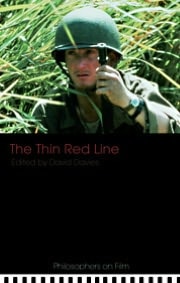
The Thin Red Line
0
0
As an Amazon Associate and affiliate partner, Menrva Books earns from qualifying purchases. Learn more
Author Description
The Thin Red Line is the third feature-length film from acclaimed director Terrence Malick, set during the struggle between American and Japanese forces for Guadalcanal in the South Pacific during World War Two. It is a powerful, enigmatic and complex film that raises important philosophical questions, ranging from the existential and phenomenological to the artistic and technical.This is the first collection dedicated to exploring the philosophical aspects of Malick’s film. Opening with a helpful introduction that places the film in context, five essays, four of which were specially commissioned for this collection, go on to examine the following: the exploration of Heideggerian themes – such as being-towards-death and the vulnerability of Dasein’s world – in The Thin Red Line; how Malick’s film explores and cinematically expresses the embodied nature of our experience of, and agency in, the world; Malick’s use of cinematic techniques, and how the style of his images shapes our affective, emotional, and cognitive responses to the film; the role that images of nature play in Malick’s cinema, and his ‘Nietzschean’ conception of human nature. The Thin Red Line is essential reading for students interested in philosophy and film or phenomenology and existentialism. It also provides an accessible and informative insight into philosophy for those in related disciplines such as film studies, literature and religion.Contributors: Simon Critchley, Hubert Dreyfus and Camilo Prince, David Davies, Amy Coplan, Iain Macdonald.
Menrva's Summary
THE THESIS
This collection investigates the intersection of cinematic artistry and philosophical inquiry within Terrence Malick’s film, The Thin Red Line. Edited by David R. Davies, the volume gathers contributions from scholars to analyze how the film functions as a medium for exploring complex existential and phenomenological concepts. The authors utilize the film's narrative and visual structure to argue that Malick’s work serves as a rigorous examination of human agency, nature, and the Heideggerian concept of being-towards-death.
THE SCOPE MAP
What You Will Find
- Analysis of Heideggerian themes including Dasein and the vulnerability of the world.
- Examination of the embodied nature of human experience and agency as expressed through cinema.
- Evaluation of cinematic techniques and how visual style influences cognitive and affective responses.
- Discussion of the role of nature imagery and Nietzschean perspectives on human nature.
THE AUTHORITY PERSPECTIVE
Experts identify this collection as a foundational text for those studying the intersection of phenomenology and film. Readers frequently note the academic density of the prose, which provides a rigorous framework for interpreting Malick’s complex visual language.
Page Count:
116
Publication Date:
2008-01-01
Publisher:
Taylor & Francis Group
ISBN-10:
0203879023
ISBN-13:
9780203879023
Philosophy
Non-Fiction
Cinema
Existentialism
Film Studies
Community Tags
Similar Books