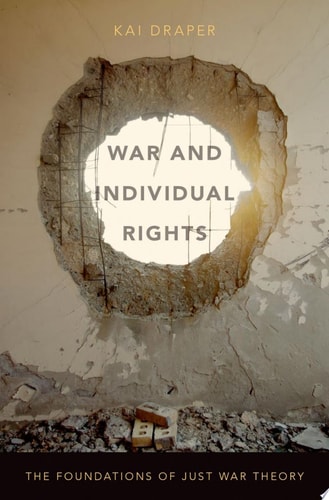
War and Individual Rights: The Foundations of Just War Theory
0
0
As an Amazon Associate and affiliate partner, Menrva Books earns from qualifying purchases. Learn more
Author Description
Kai Draper begins his book with the assumption that individual rights exist and stand as moral obstacles to the pursuit of national no less than personal interests. That assumption might seem to demand a pacifist rejection of war, for any sustained war effort requires military operations that predictably kill many noncombatants as "collateral damage," and presumably at least most noncombatants have a right not to be killed. Yet Draper ends with the conclusion that sometimes recourse to war is justified.In making his argument, he relies on the insights of John Locke to develop and defend a framework of rights to serve as the foundation for a new just war theory. Notably missing from that framework is any doctrine of double effect. Most just war theorists rely on that doctrine to justify injuring and killing innocent bystanders, but Draper argues that various prominent formulations of the doctrine are either untenable or irrelevant to the ethics of war. Ultimately he offers a single principle for assessing whether recourse to war would be justified. He also explores in some detail the issue of how to distinguish discriminate from indiscriminate violence in war, arguing that some but not all noncombatants are liable to attack.
Menrva's Summary
THE THESIS
This book investigates how individual rights can be reconciled with the moral permissibility of war, specifically addressing the conflict between the right to life and the collateral damage inherent in military operations. Kai Draper, a philosopher specializing in ethics and political theory, utilizes a Lockean framework to construct a new foundation for just war theory. He challenges traditional reliance on the doctrine of double effect, arguing that it is either logically untenable or practically irrelevant to the ethics of modern warfare.
THE SCOPE MAP
What You Will Find
- A Lockean-based framework for individual rights in the context of conflict
- A critical analysis of the doctrine of double effect
- A single principle for assessing the justification of recourse to war
- Criteria for distinguishing between discriminate and indiscriminate violence
Scope Limits
- The text does not provide a comprehensive history of warfare or military strategy
- It does not address every possible nuance of international law beyond the philosophical foundations of rights
THE AUTHORITY PERSPECTIVE
Scholars and students of political philosophy frequently note the rigorous, analytical density of Draper's prose. Experts highlight this work as a significant contribution to the field for its systematic rejection of the doctrine of double effect in favor of a rights-based approach.
Page Count:
272
Publication Date:
2015-01-01
Publisher:
Oxford University Press
ISBN-10:
0190463678
ISBN-13:
9780190463670
History
Philosophy
War Studies
Just war
Military History
Ethics
War
War Philosophy
Community Tags
Similar Books