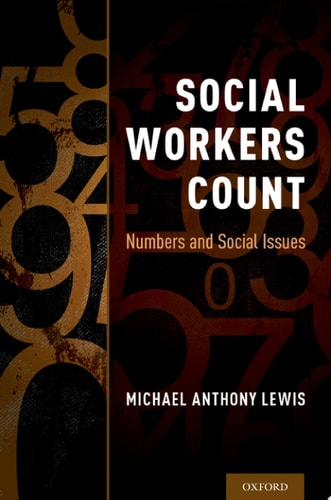
Social Workers Count: Numbers and Social Issues
0
0
As an Amazon Associate and affiliate partner, Menrva Books earns from qualifying purchases. Learn more
Author Description
Social work students are often required to take courses in the domain of quantitative literacy, but struggle with the relative inattention to policy and social issues of special significance to professional social workers. These courses, as well as the books written for them, may also present mathematical demands many social workers are unprepared to meet. However, issues such as poverty measurement, adjustment of the purchasing power of social welfare benefits, demographic strains on the Social Security program, and probability theory as a means of estimating the likelihood of child abuse or neglect represent only a few of the many quantitative problems related to the concerns of professional social workers. Written in an accessible style, Social Workers Count provides social workers and those in neighboring disciplines with the background necessary to engage the quantitative aspects of policy and social issues relevant to social work.
Menrva's Summary
THE THESIS
How can social workers effectively integrate quantitative literacy into their professional practice to better address complex social policy and welfare issues? Michael Anthony Lewis, an expert in social work education, addresses the gap between traditional mathematical instruction and the practical needs of social service professionals. He argues that by mastering specific quantitative skills, social workers can more accurately analyze data related to poverty, social security, and child welfare, thereby improving their advocacy and policy-making capabilities.
THE SCOPE MAP
What You Will Find
- Analysis of poverty measurement and purchasing power adjustments for welfare benefits.
- Examination of demographic trends impacting the Social Security program.
- Application of probability theory in assessing risks for child abuse and neglect.
- Methodologies for interpreting statistical data within social work contexts.
Scope Limits
- The text does not provide an exhaustive manual for advanced statistical software or complex econometric modeling.
- It does not cover qualitative research methodologies or ethnographic study techniques.
THE AUTHORITY PERSPECTIVE
Educators and practitioners frequently cite this text as a bridge between abstract mathematical concepts and the specific, high-stakes requirements of social work policy. Experts highlight the book's success in demystifying quantitative analysis for students who may lack a strong background in mathematics.
Page Count:
223
Publication Date:
2018-01-01
Publisher:
Oxford University Press
ISBN-10:
0190467150
ISBN-13:
9780190467159
Public Policy
Introduction to Social WorkWelfare
Statistics
Social Work
Education
Social policy
Community Tags
Similar Books