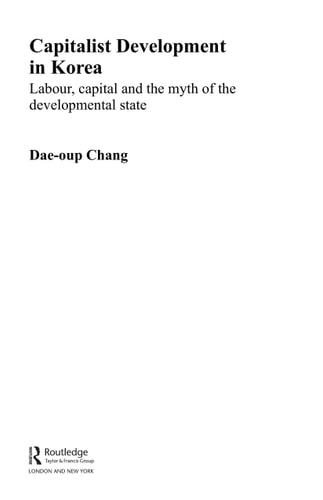
Capitalist Development in Korea: Labour, Capital and the Myth of the Developmental State
0
0
As an Amazon Associate and affiliate partner, Menrva Books earns from qualifying purchases. Learn more
Author Description
Contrary to the widely-held view that the East Asian "developmental state" is neutral in terms of the relationship between capital and labour – a benign co-operation between state officials and businessmen to organise economic development – this book argues that in fact the developmental state exists to promote the interests of capital over the interests of labour. Dae-oup Chang asserts that there has been a deliberate mystification concerning the reality of this process. This book presents a radical, Marxist critique of state development theory. It both explains the exploitative functions of the state, looking at the emergence of the particular form of capitalist state in the context of the formation and reproduction of capital relations in Korea; and also traces the origin and development of the process of mystification whereby the capitalist state has been characterised as the autonomous developmental state. In addition, the book provides a comprehensive analysis of labour relations in Korea both before and after the 1998 financial crisis, demonstrating continuing capital relations, state transition and class struggle.
Menrva's Summary
THE THESIS
This book investigates whether the East Asian developmental state model acts as a neutral economic facilitator or as a mechanism for prioritizing capital interests over labor. Author Dae-oup Chang utilizes a Marxist framework to challenge the prevailing consensus that state-led development in Korea was a benign partnership. By examining the historical formation of capital relations, the text argues that the state has actively functioned to suppress labor and mystify its own exploitative role in the national economy.
THE SCOPE MAP
What You Will Find
- Historical analysis of the formation and reproduction of capital relations in Korea.
- A critical evaluation of the developmental state theory through a Marxist lens.
- Comparative study of labor relations before and after the 1998 financial crisis.
- Examination of the mechanisms used to characterize the state as an autonomous entity.
THE AUTHORITY PERSPECTIVE
Scholars in political economy recognize this work as a significant challenge to mainstream developmental state literature. Readers frequently note the dense, theoretical nature of the prose, which is intended for an academic audience familiar with Marxist critique.
Page Count:
198
Publication Date:
2008-01-01
Publisher:
Routledge
ISBN-10:
0203887840
ISBN-13:
9780203887844
Economics
History
South Korea
Capitalism
Marxism
Labor Studies
Community Tags
Similar Books