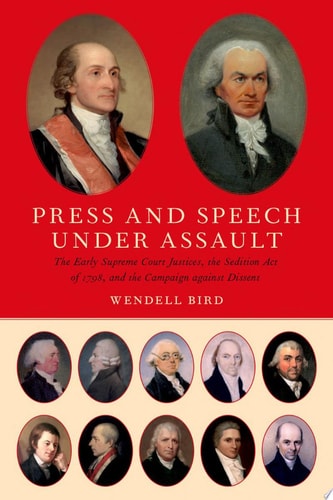
Press and Speech Under Assault
0
0
As an Amazon Associate and affiliate partner, Menrva Books earns from qualifying purchases. Learn more
Author Description
The Early Supreme Court Justices Wrestled With How Much Press And Speech Is Protected By Freedoms Of Press And Speech, Before And Under The First Amendment, And With Whether The Sedition Act Of 1798 Violated Those Freedoms. This Book Discusses The Twelve Supreme Court Justices Before John Marshall, Their Views Of Liberties Of Press And Speech, And The Sedition Act Prosecutions Over Which Some Of Them Presided. The Book Begins With The Views Of The Pre-marshall Justices About Freedoms Of Press And Speech, Before The Struggle Over The Sedition Act. It Finds That Their Understanding Was Strikingly More Expansive Than The Narrow Definition Of Sir William Blackstone, Which Is Usually Assumed To Have Dominated The Period. Not One Justice Of The Supreme Court Adopted That Narrow Definition Before 1798, And All Expressed Strong Commitments To Those Freedoms. The Book Then Discusses The Views Of The Early Supreme Court Justices About Freedoms Of Press And Speech During The National Controversy Over The Sedition Act Of 1798 And Its Constitutionality. It Finds That, Though Several Of The Justices Presided Over Sedition Act Trials, The Early Justices Divided Almost Evenly Over That Issue With An Unrecognized Half Opposing Its Constitutionality, Rather Than Unanimously Supporting The Act As Is Generally Assumed. The Book Similarly Reassesses The Federalist Party Itself, And Finds That An Unrecognized Minority Also Challenged The Constitutionality Of The Sedition Act And The Narrow Blackstone Approach During 1798-1801, And That An Unrecognized Minority Of The Other States Did As Well In Considering The Virginia And Kentucky Resolutions. The Book Summarizes The Recognized Fourteen Prosecutions Of Newspaper Editors And Other Opposition Members Under The Sedition Act Of 1798. It Sheds New Light On The Recognized Cases By Identifying And Confirming Twenty-two Additional Sedition Act Prosecutions. At Each Of These Steps, This Book Challenges Conventional Views In Existing Histories Of
Menrva's Summary
THE THESIS
This book investigates the historical understanding of press and speech freedoms among early Supreme Court justices and challenges the conventional narrative surrounding the Sedition Act of 1798. Author Wendell R. Bird, a legal historian, utilizes primary source documents and judicial records to argue that early American legal thought was significantly more expansive regarding civil liberties than the restrictive Blackstone definition typically cited by scholars. By re-examining the judicial records of the twelve justices serving before John Marshall, the text provides a revised framework for understanding the constitutional debates of the late 18th century.
THE SCOPE MAP
What You Will Find
- Analysis of the legal philosophies of the twelve Supreme Court justices serving prior to John Marshall.
- A comprehensive reassessment of the Sedition Act of 1798 and its constitutional challenges.
- Documentation of thirty-six total Sedition Act prosecutions, including twenty-two previously unrecognized cases.
- Examination of the Virginia and Kentucky Resolutions as indicators of state-level opposition to federal restrictions.
Scope Limits
- The analysis is strictly confined to the period between 1798 and 1801.
- The text focuses primarily on judicial and political responses rather than broader social or cultural impacts of the era.
THE AUTHORITY PERSPECTIVE
Legal scholars and historians frequently cite this work for its rigorous archival research and its capacity to overturn long-standing assumptions about early American jurisprudence. Readers often note the academic density of the prose, which serves as a foundational resource for those studying the evolution of First Amendment protections.
Page Count:
432
Publication Date:
2016-01-01
Publisher:
Oxford University Press
ISBN-10:
0190461632
ISBN-13:
9780190461638
History
Legal History
United States
Constitutional Law
Community Tags
Similar Books