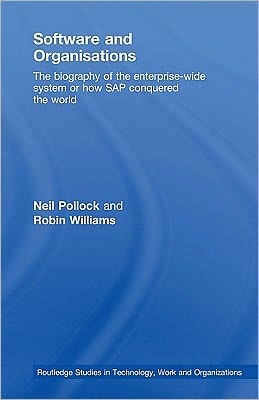
Software and Organisations: The Biography of the Enterprise-Wide System or How SAP Conquered the World
0
0
As an Amazon Associate and affiliate partner, Menrva Books earns from qualifying purchases. Learn more
Author Description
This is the first book that addresses the genesis and career of the modern day enterprise system in a comprehensive and robust manner. It does so through setting out a new approach for the study of packaged solutions and presents novel empirical studies based on in-depth ethnographic and longitudinal research conducted within supplier organisations and other relevant sites. The authors shift the debate within the social study of information systems, from one that is primarily focused on ‘implementation studies’, to one that follows software as it evolves, matures and crosses organisational boundaries. Through tracing and comparing the ‘biography’ of a number of software systems the authors develop a new vocabulary for the dynamics that surround standardised software. Original in its approach, this book draws on a number of ethnographic studies in supplier organisations, user settings, user forums, and applies theories from the Sociology of Technology, Technology Studies, Innovation Studies, and beyond. As such it will be of interest across all of these subject areas and to researchers from the wider fields of Information Systems and Business Studies.
Menrva's Summary
THE THESIS
This book investigates the historical genesis, evolution, and global proliferation of enterprise-wide software systems, specifically focusing on the rise of SAP. Neil Pollock, a scholar in the sociology of technology and information systems, utilizes a longitudinal and ethnographic research framework to move beyond traditional implementation-focused studies. By tracing the lifecycle of packaged software across organizational boundaries, the author argues that these systems possess a distinct 'biography' that shapes and is shaped by the corporate environments they inhabit.
THE SCOPE MAP
What You Will Find
- Longitudinal ethnographic research conducted within software supplier organizations and user sites.
- A new theoretical vocabulary for analyzing the dynamics of standardized enterprise software.
- Comparative analysis of multiple software systems as they evolve and mature over time.
- Theoretical applications from the fields of Sociology of Technology, Innovation Studies, and Business Studies.
THE AUTHORITY PERSPECTIVE
Experts in the field of information systems recognize this work as a significant shift in how scholars analyze the impact of packaged software on organizational structures. Researchers frequently highlight the book's methodological rigor and its ability to bridge the gap between technical implementation and sociological theory.
Page Count:
348
Publication Date:
2009-01-01
Publisher:
Routledge
ISBN-10:
0203891945
ISBN-13:
9780203891940
Business
Sociology
Information Management
Technology
Computer software
Information Systems
Community Tags
Similar Books