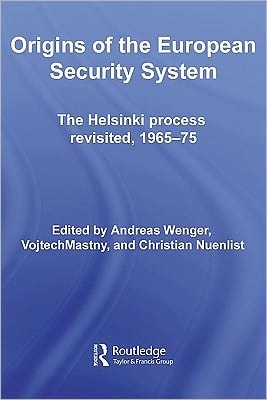
Origins of the European Security System: The Helsinki Process Revisited, 1965-75
0
0
As an Amazon Associate and affiliate partner, Menrva Books earns from qualifying purchases. Learn more
Author Description
This edited volume explores the significance of the early ‘Helsinki process’ as a means of redefining and broadening the concept of security during the latter half of the Cold War. The early Helsinki process introduced innovative confidence-building measures, and made human rights a requirement of a legitimate and well-functioning international system, thus providing the framework for disarmament in Europe in the mid-1980s, as well as the inspiration for the later demise of Communism in Europe. Using newly declassified archives, the book explores the positions of the two superpowers and the crucial impact of European Community member states, which introduced European values into the Cold War debate on security. It also shows how Eastern and Central European nations, such as Poland, did not restrict themselves to providing support to Moscow but, rather, pursued interests of their own. The volume sheds light on the complementary role of the neutrals as mediators and special negotiators in the multilateral negotiations; on the interdependence of politics and economics; and on the link between military security and the CSCE process.
Menrva's Summary
THE THESIS
This volume investigates how the early Helsinki process fundamentally redefined the concept of security and human rights within the international system during the Cold War. Andreas Wenger, an expert in international security policy, utilizes newly declassified archival materials to analyze the complex diplomatic interactions between the superpowers, European Community members, and Eastern Bloc nations. The work argues that the Helsinki process was not merely a byproduct of superpower relations but a critical framework that integrated human rights and economic interdependence into the broader discourse of European military security.
THE SCOPE MAP
What You Will Find
- Analysis of the diplomatic negotiations occurring between 1965 and 1975.
- Examination of the role of neutral states as mediators in multilateral security talks.
- Investigation into the independent foreign policy interests of Eastern European nations like Poland.
- Assessment of the link between human rights, economic cooperation, and military disarmament.
THE AUTHORITY PERSPECTIVE
Scholars and historians frequently cite this volume as a critical resource for understanding the nuances of Cold War diplomacy and the origins of modern European security structures. Experts highlight the text for its rigorous use of declassified archives to challenge traditional, superpower-centric narratives of the era.
Page Count:
276
Publication Date:
2008-01-01
Publisher:
Routledge
ISBN-10:
0203895304
ISBN-13:
9780203895306
History
Cold War
Detente
International relations
European History
Community Tags
Similar Books