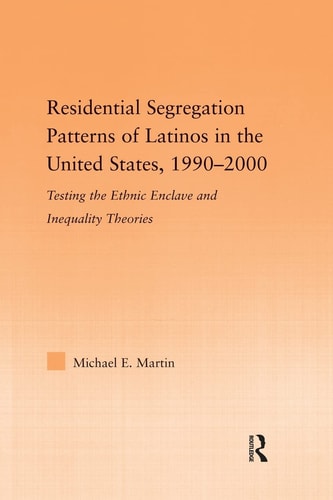
Residential Segregation Patterns of Latinos in the United States, 1990-2000
0
0
As an Amazon Associate and affiliate partner, Menrva Books earns from qualifying purchases. Learn more
Author Description
Historically, Residential Segregation Of Latinos Has Generally Been Seen As A Result Of Immigration And The Process Of Self-segregation Into Ethnic Enclaves. The Only Theoretical Exception To Ethnic Enclave Latino Segregation Has Been The Structural Inequality Related To Latinos That Have A High Degree Of African Ancestry. This Study Of The 331 Metropolitan Area In The United States Between 1990 And 2000 Shows That Latinos Are Facing Structural Inequalities Outside Of The Degree Of African Ancestry. The Results Of The Author's Research Suggest That Latino Segregation Is Due To The Mobility Of Latinos And Structural Barriers In Wealth Creation Due To Limited Housing Equity And Limited Occupational Mobility. In Addition, Latino Suburbanization Appears To Be A Segregation Force Rather Than An Integration Force. This Study Also Shows That Mexicans, Puerto Ricans And Cubans Have Different Experiences With Residential Segregation. Residential Segregation Of Cubans Does Not Appear To Be A Problem In The U.s. Puerto Ricans Continue To Be The Most Segregated Latino Sub-group And Inequality Is A Large Factor In Puerto Rican Segregation. A More In-depth Analysis Reveals That The Puerto Rican Experience Is Bifurcated Between The Older Highly Segregated Enclaves Where Inequality Is A Large Problem And New Enclaves Where Inequality And Segregation Are Not An Issue. The Mexican Residential Segregation Experience Reflects That Immigration And Mobility Are Important Factors But Previous Theorists Have Underestimated The Barriers Mexicans Face In Obtaining Generational Wealth And Moving From The Ethnic Enclave Into The American Mainstream.
Menrva's Summary
THE THESIS
This study investigates whether residential segregation among Latinos in the United States is primarily a product of voluntary ethnic clustering or a consequence of structural socioeconomic barriers. Michael E. Martin utilizes demographic data from 331 metropolitan areas between 1990 and 2000 to challenge traditional theories that attribute Latino segregation solely to immigration patterns and self-segregation. By examining housing equity, occupational mobility, and wealth creation, the author argues that structural inequalities play a more significant role in shaping residential patterns than previously acknowledged by academic consensus.
THE SCOPE MAP
What You Will Find
- Comparative analysis of residential patterns across 331 U.S. metropolitan areas from 1990 to 2000.
- Examination of subgroup-specific experiences for Mexican, Puerto Rican, and Cuban populations.
- Quantitative assessment of the impact of housing equity and occupational mobility on segregation.
- Evaluation of suburbanization as a mechanism for continued segregation rather than integration.
THE AUTHORITY PERSPECTIVE
Experts identify this work as a critical contribution to urban sociology for its nuanced differentiation between various Latino subgroups. Readers frequently note the academic density of the prose and the author's rigorous application of demographic data to dismantle monolithic views of ethnic enclaves.
Page Count:
0
Publication Date:
2006-01-01
Publisher:
Taylor & Francis Group
ISBN-10:
0203943139
ISBN-13:
9780203943137
Discrimination in housing
Public Policy
Urban Studies
Hispanic Americans
Sociology
Social Science
Ethnic Studies
Demography