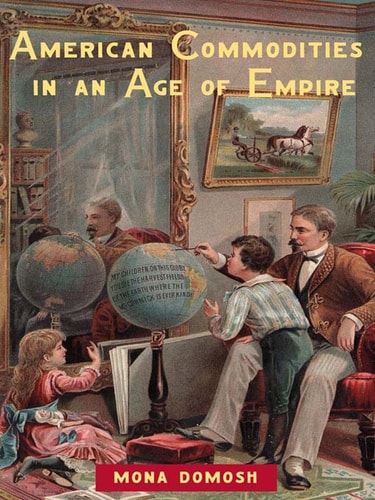
American Commodities in an Age of Empire
0
0
As an Amazon Associate and affiliate partner, Menrva Books earns from qualifying purchases. Learn more
Author Description
American Commodities in an Age of Empire is a novel interpretation of the relationship between consumerism, commercialism, and imperialism during the first empire building ear of America in the late 19th and early 20th centuries. Unlike other empires in history, which were typically built on military power, the first American empire was primarily a commercial one, dedicated to pushing products overseas and dominating foreign markets. While the American government was important, it was the great capitalist firms of America - Heinz, Singer, McCormick, Kodak, Standard Oil - that drove the imperial process, explicitly linking the purchase of consumer goods overseas with "civilization" Their persistent message to America's prospective customers was, "buy American products and join the march of progress." American Commodities in an Age of Empire also explores how the images of peoples overseas conveyed through goods elevated America's sense of itself in the world. As well, the racial and gendered messages apparent in ads for sewing machines, processed food, and agricultural tools were foundational to the development of American imperialism and to American identity. That vision continues to shape American imperialism up to the present. A bold new interpretation of the commercial roots of American global power, American Commodities in an Age of Empire does for the cultural dimensions of America imperialism what Anne McClintock did for British imperialism in her classic Imperial Leather.
Menrva's Summary
THE THESIS
This book investigates how American commercial expansion and consumer goods served as the primary instruments of imperialism during the late 19th and early 20th centuries. Mona Domosh, a professor of geography, utilizes historical business records and advertising archives to argue that American global influence was built not through military conquest, but through the aggressive export of corporate products. She posits that firms like Heinz and Singer defined American identity and progress for foreign markets, effectively linking consumerism to the expansion of national power.
THE SCOPE MAP
What You Will Find
- Analysis of major American corporations including Heinz, Singer, McCormick, Kodak, and Standard Oil.
- Examination of how advertising imagery utilized racial and gendered tropes to promote American products.
- Historical study of the transition from domestic commercialism to international market dominance.
- Evaluation of the cultural connection between consumer goods and the concept of civilization.
THE AUTHORITY PERSPECTIVE
Scholars recognize this work as a significant contribution to the study of cultural imperialism and the history of American capitalism. Readers frequently note the author's ability to synthesize complex economic history with accessible cultural analysis.
Page Count:
216
Publication Date:
2006-01-01
Publisher:
Taylor and Francis
ISBN-10:
0203954858
ISBN-13:
9780203954850
Economics
History
American History
Imperialism
Sociology
Community Tags
Other Editions(5)

Similar Books















Reader Comments
Share Your Thoughts
No comments yet. Be the first to share your thoughts!