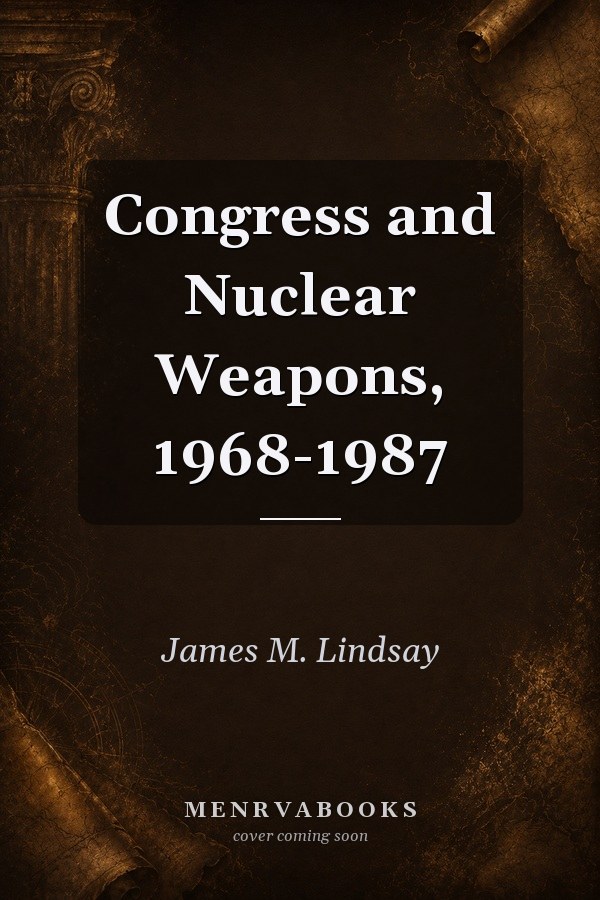
Congress and Nuclear Weapons, 1968-1987
0
0
As an Amazon Associate and affiliate partner, Menrva Books earns from qualifying purchases. Learn more
Author Description
Lindsay (political science, U. of Iowa) traces the rise of congressional interest in nuclear weapons policy since the 1960s. Combining analyses of committee and floor behavior with case studies of four important programs--the Trident submarine and the MX, Pershing II, and ASAT missiles--he finds that the influence of Congress over nuclear weapons policy has dramatically increased. Annotation copyrighted by Book News, Inc., Portland, OR
Menrva's Summary
THE THESIS
The influence of Congress over nuclear weapons policy has dramatically increased since the 1960s. James M. Lindsay, a political science scholar, traces this rise by examining congressional interest in nuclear weapons policy from 1968 to 1987. The book combines analyses of committee and floor behavior with detailed case studies of four significant weapons programs: the Trident submarine, and the MX, Pershing II, and ASAT missiles. Lindsay's research demonstrates a profound shift in the balance of power regarding nuclear policy decisions.
THE SCOPE MAP
- Analysis of congressional behavior in committees and on the floor regarding nuclear weapons policy.
- Case studies of the Trident submarine program.
- Case studies of the MX missile program.
- Case studies of the Pershing II missile program.
- Case studies of the ASAT (Anti-Satellite) missile program.
- Examination of the period from 1968 to 1987, focusing on the evolution of congressional influence.
- Identification of factors contributing to the increased role of Congress in nuclear weapons policy.
THE AUTHORITY PERSPECTIVE
This book is recognized for its detailed historical analysis of Congress's growing role in nuclear weapons policy during a critical period of the Cold War. Scholars and students of political science and history find its combination of legislative behavior analysis and specific program case studies to be a robust approach. The work is noted for its empirical grounding and its contribution to understanding the dynamics of oversight and decision-making in national security matters. It provides a clear, evidence-based account of how legislative bodies can shape foreign and defense policy.
Page Count:
223
Publication Date:
1988-01-01
Publisher:
Yale University
ISBN-10:
0608060801
ISBN-13:
9780608060804
Non-Fiction
History
Politics
Cold War
Military History
Community Tags
Similar Books