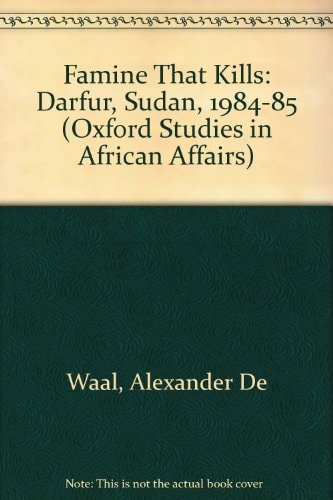
Famine That Kills: Darfur, Sudan, 1984-1985
0
0
As an Amazon Associate and affiliate partner, Menrva Books earns from qualifying purchases. Learn more
Author Description
Famine that Kills is a unique study based on detailed field research carried out during the terrible famine of 1984-85 in the Darfur region of Sudan. De Waal adopts the original approach of analyzing the famine from the perspective of the rural people who suffered through it and in the process uncovers a number of new and important insights. When news of the famine broke, it was predicted that without massive food aid, millions of people would starve. The aid did not arrive, yet millions continued to survive. De Waal argues that death was caused primarily by disease brought about by social disruption. In addition, the priority for rural people during the crisis was not to try to save every life, but instead to preserve their way of life for the future. Consequently, he concludes, the huge international famine relief effort was largely irrelevant to their survival. Recounting the untold story of the Sudanese famine--how rural Sudanese were able to survive on their own resources, using skill, local knowledge, and great tenacity--de Waal's multidisciplinary study will have profound implications, not just for famine relief policies, but for our very conception of "famine" itself.
Menrva's Summary
THE THESIS
The book investigates the causes and survival mechanisms of the 1984-1985 famine in Darfur, Sudan. Alexander de Waal, drawing on extensive field research, analyzes the famine from the perspective of the rural Sudanese people who endured it. He challenges the conventional understanding of famine relief by arguing that disease, exacerbated by social disruption, was the primary cause of death, rather than a simple lack of food aid. De Waal posits that the survival strategies of the rural population prioritized preserving their way of life for the future, rendering the massive international relief efforts largely irrelevant.
THE SCOPE MAP
- Analysis of the 1984-1985 famine in Darfur, Sudan.
- Field research conducted during the famine period.
- Perspective of rural Sudanese people on their survival.
- Argument that disease and social disruption were primary causes of death.
- Examination of survival strategies focused on future preservation.
- Critique of the relevance and impact of international famine relief efforts.
- Exploration of the concept of 'famine' itself.
THE AUTHORITY PERSPECTIVE
This multidisciplinary study by Alexander de Waal offers profound implications for famine relief policies and the very conception of famine. The book's original approach, centering the experiences of those who suffered the crisis, uncovers new insights into survival mechanisms. By highlighting the resilience and local knowledge of the rural Sudanese, it challenges the efficacy of large-scale external interventions. The work is recognized for its detailed field research and its critical re-evaluation of humanitarian aid during crises.
Page Count:
258
Publication Date:
1989-01-01
Publisher:
Clarendon Press
ISBN-10:
0198277490
ISBN-13:
9780198277491
Non-Fiction
History
Africa
Community Tags
Similar Books