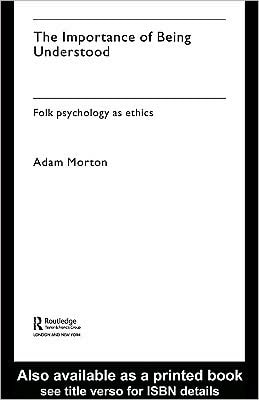
The Importance of Being Understood: Folk Psychology As Ethics
0
0
As an Amazon Associate and affiliate partner, Menrva Books earns from qualifying purchases. Learn more
Author Description
The Importance of Being Understood is an innovative and thought-provoking exploration of the links between the way we think about each other's mental states and the fundamentally cooperative nature of everyday life. Adam Morton begins with a consideration of 'folk psychology', the tendency to attribute emotions, desires, beliefs and thoughts to human minds. He takes the view that it is precisely this tendency that enables us to understand, predict and explain the actions of others, which in turn helps us to decide on our own course of action. This relection suggests, claims Morton, that certain types of cooperative activity are dependent on everyday psychological understanding conversely, that we act in such a way as to make our actions easily intelligible to others so that we can benefit from being understood. This idea of 'beneficial circularities' is at the core of Morton's investigation of the interdependencies between folk psychology and social behaviour: we understand each other because we have learned to make ourselves intelligible. Using examples of cooperative activities such as car driving and playing tennis, Adam Morton analyses the concepts of belief and simulation, the idea of explanation by motive, and the causal force of psychological explanation. In addition to argument and analysis, Morton also includes more speculative explorations of topics such as moral progress and presents a new point of view on how and why cultures differ. The Importance of Being Understood forges new links between ethics and the philosophy of mind and will be of interest to anyone in either field, as well as developmental psychologists.
Menrva's Summary
THE THESIS
This book investigates the fundamental question of how the human capacity for folk psychology—the attribution of mental states to others—functions as a necessary mechanism for cooperative social ethics. Adam Morton, a philosopher specializing in the philosophy of mind, utilizes a framework of 'beneficial circularities' to argue that human social interaction is predicated on a mutual effort to remain intelligible to one another. By examining the intersection of cognitive prediction and moral behavior, he posits that our ability to understand others is inextricably linked to our own efforts to be understood.
THE SCOPE MAP
What You Will Find
- An analysis of folk psychology as a tool for predicting and explaining human action.
- Theoretical frameworks regarding belief, simulation, and motive-based explanation.
- Practical examples of cooperative activities including car driving and tennis.
- Speculative explorations into the nature of moral progress and cultural divergence.
THE AUTHORITY PERSPECTIVE
Scholars and students of philosophy and developmental psychology frequently cite this work for its unique synthesis of ethics and cognitive theory. Readers often note that while the text presents complex philosophical arguments, it remains accessible through the use of concrete, everyday examples.
Page Count:
240
Publication Date:
2005-01-01
Publisher:
Taylor & Francis Group
ISBN-10:
0203994930
ISBN-13:
9780203994931
Psychology
Philosophy
Communication
Ethics
Social Science
Community Tags
Similar Books