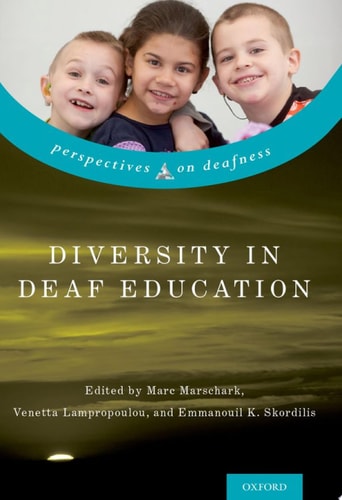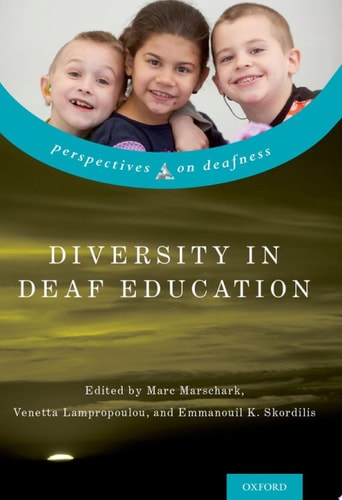
Diversity In Deaf Education
0
0
As an Amazon Associate and affiliate partner, Menrva Books earns from qualifying purchases. Learn more
Author Description
Deaf Children Are Not Hearing Children Who Can't Hear. Beyond Any Specific Effects Of Hearing Loss, As A Group They Are Far More Diverse Than Hearing Peers. Lack Of Full Access To Language, Incidental Learning, And Social Interactions As Well As The Possibility Of Secondary Disabilities Means That Deaf Learners Face A Variety Of Challenges In Academic Domains. Technological Innovations Such As Digital Hearing Aids And Cochlear Implants Have Improved Hearing And The Possibility Of Spoken Language For Many Deaf Learners, But Parents, Teachers, And Other Professionals Are Just Now Coming To Recognize That There Are Cognitive, Experiential, And Social-emotional Differences Between Deaf And Hearing Students Likely To Affect Academic Outcomes. Sign Languages And Schools And Programs For Deaf Learners Thus Remain An Important Part Of The Continuum Of Services Needed For This Diverse Population. Understanding Such Diversity And Determining Ways In Which To Accommodate Them Must Become A Top Priority In Educating Deaf Learners. Through The Participation Of An International, Interdisciplinary Set Of Scholars, Diversity In Deaf Education Takes A Broad View Of Learning And Academic Progress, Considering The Whole Child In The Context Of The Families, Languages, Educational Settings In Which They Are Immersed. In Adopting This Perspective, The Complexities And Commonalities In The Social, Emotional, Cognitive, And Linguistic Mosaic Of Which The Deaf Child Is A Part, Are Captured. It Is Only Through Such A Holistic Consideration Of Diverse Children Developing Within Diverse Settings That We Can Understand Their Academic Potentials.
Menrva's Summary
THE THESIS
This volume investigates how the inherent diversity within the deaf student population necessitates a shift in educational approaches to better support academic and social-emotional development. The authors, a team of international and interdisciplinary scholars, argue that deaf children possess unique cognitive and experiential profiles that are distinct from their hearing peers. By examining the intersection of language access, secondary disabilities, and technological interventions, the text provides a framework for educators and parents to move beyond a one-size-fits-all model of instruction.
THE SCOPE MAP
What You Will Find
- Analysis of cognitive, social-emotional, and linguistic development in deaf children.
- Evaluation of the impact of technological aids like cochlear implants on academic outcomes.
- Examination of the role of sign language and specialized educational programs.
- Holistic perspectives on the influence of family dynamics and educational environments.
Scope Limits
- The text does not provide a singular, prescriptive curriculum for classroom implementation.
- It does not focus exclusively on a specific geographic region or a single pedagogical philosophy.
THE AUTHORITY PERSPECTIVE
Experts recognize this work as a comprehensive resource for understanding the multifaceted nature of deaf education in the modern era. Readers frequently note the academic density of the prose, which serves as a foundational text for professionals and researchers in the field of special education.
Page Count:
376
Publication Date:
2016-01-01
Publisher:
Oxford University Press
ISBN-10:
0190493089
ISBN-13:
9780190493080
Psychology
Education
Special Education
Deaf Studies
Pedagogy
Sociology