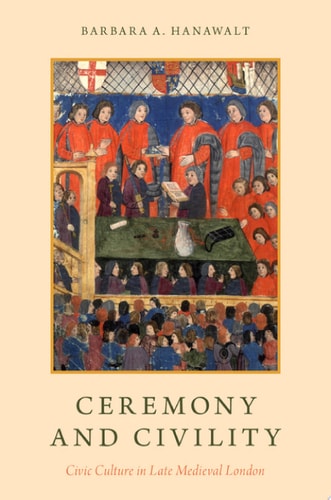
Ceremony and Civility: Civic Culture in Late Medieval London
0
0
As an Amazon Associate and affiliate partner, Menrva Books earns from qualifying purchases. Learn more
Author Description
Medieval London, Like All Premodern Cities, Had A Largely Immigrant Population-only A Small Proportion Of The Inhabitants Were Citizens-and The Newly Arrived Needed To Be Taught The Civic Culture Of The City In Order For That City To Function Peacefully. Ritual And Ceremony Played Key Roles In This Acculturation Process. In Ceremony And Civility, Barbara A. Hanawalt Shows How, In The Late Middle Ages, London's Elected Officials And Elites Used Ceremony And Ritual To Establish Their Legitimacy And Power. In A Society In Which Hierarchical Authority Was Most Commonly Determined By Inheritance Of Title And Office, Or Sanctified By Ordination, Civic Officials Who Had Been Elected To Their Posts Relied On Rituals To Cement Their Authority And Dominance. Elections And Inaugurations Had To Be Very Public And Visually Distinct In Order To Quickly Communicate With The Masses: The Robes Of Office Needed To Distinguish The Officers So That Everyone Would Know Who They Were. The Result Was A Colorful Civic Pageantry. Newcomers Found Their Places Within This Structure In Various Ways. Apprentices Entering The City To Take Up A Trade Were Educated In Civic Culture By Their Masters. Gilds Similarly Used Rituals, Oath Swearing, And Distinctive Livery To Mark Their Members' Belonging. But These Public Shows Of Belonging And Orderly Civic Life Also Had A Dark Side. Those Who Rebelled Against Authority And Broke The Civic Ordinances Were Made Spectacles Through Ritual Humiliations And Public Parades Through The Streets So That Others Could Take Heed Of These Offenders Of The Law. An Accessible Look At Late Medieval London Through The Lens Of Civic Ceremonies And Dispute Resolution, Ceremony And Civility Synthesizes Archival Research With Existing Scholarship To Show How An Ever-shifting Population Was Enculturated Into Premodern London.
Menrva's Summary
THE THESIS
This book investigates how late medieval London officials utilized public ritual and ceremony to establish political legitimacy and integrate a transient, immigrant population into a cohesive civic culture. Barbara A. Hanawalt, a respected historian of medieval social history, draws upon extensive archival research to analyze the intersection of power, performance, and social order. She argues that in a society where authority was often inherited or divinely ordained, elected officials relied on visual pageantry and public spectacle to solidify their status and enforce social norms among the city's diverse inhabitants.
THE SCOPE MAP
What You Will Find
- Analysis of civic pageantry, including the use of robes, elections, and inaugurations to communicate authority.
- Examination of the acculturation process for apprentices and newcomers through gild rituals and oath swearing.
- Investigation of the punitive side of civic culture, specifically ritual humiliation and public displays of lawbreakers.
Scope Limits
- The study focuses primarily on the late medieval period and does not extend into the early modern transition or the post-Reformation era.
- The analysis is centered on London and does not provide a comparative study of other European urban centers of the same period.
THE AUTHORITY PERSPECTIVE
Scholars and students of medieval history frequently cite this work for its clear synthesis of archival data and its accessible exploration of urban social dynamics. Experts highlight the book as a valuable contribution to understanding how premodern cities maintained order through symbolic communication rather than solely through centralized state force.
Page Count:
320
Publication Date:
2017-01-01
Publisher:
Oxford University Press
ISBN-10:
0190490411
ISBN-13:
9780190490416
History
Political History
Cultural History
Sociology
London History
London England
Community Tags
Similar Books