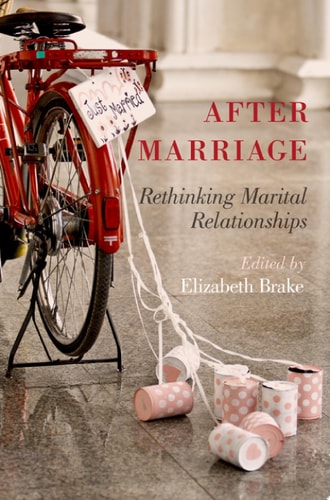
After Marriage: Rethinking Marital Relationships
0
0
As an Amazon Associate and affiliate partner, Menrva Books earns from qualifying purchases. Learn more
Author Description
This collection of essays by liberal and feminist philosophers addresses the question of whether marriage reform ought to stop with same-sex marriage. Some philosophers have recently argued that marriage is illiberal and should be abolished or radically reformed to include groups and non-romantic friendships. In response, Simon May argues that marriage law can be justified without an illiberal appeal to an ideal relationship type, and Ralph Wedgwood argues that the liberal values which justify same-sex marriage do not justify further extension. Other authors argue for new legal forms for intimate relationships. Marriage abolitionist Clare Chambers argues that piecemeal directives rather than relationship contracts should replace marriage, and Samantha Brennan and Bill Cameron argue for separating marriage and parenting, with parenting rather than marriage becoming, legally and socially, the foundation of the family. Elizabeth Brake argues for a non-hierarchical friendship model for marriage. Peter de Marneffe argues that polygamy should be decriminalized, but that the liberal state need not recognize it, while Laurie Shrage argues that polygamy could be legally structured to protect privacy and equality. Dan Nolan argues for temporary marriage as a legal option, while Anca Gheaus argues that marital commitments are problematic instruments for securing the good of romantic and sexual love. Taken together, these essays challenge contemporary understandings of marriage and the state's role in it.
Menrva's Summary
THE THESIS
This collection of essays investigates whether the legal and social institution of marriage should be abolished, radically reformed, or extended beyond its current traditional and same-sex definitions. Editor Elizabeth Brake, alongside a group of liberal and feminist philosophers, examines the intersection of state policy and intimate relationships. The contributors analyze whether liberal values support the expansion of marriage to include non-romantic friendships, polyamorous groups, or temporary contracts, or if the institution itself is inherently illiberal. By presenting diverse viewpoints, the text provides a rigorous framework for evaluating the future of legal recognition for personal unions.
THE SCOPE MAP
What You Will Find
- Philosophical arguments regarding the decriminalization of polygamy and the state's role in private life.
- Proposals for alternative legal structures, including relationship contracts and parenting-focused family models.
- Critiques of marriage as an instrument for securing romantic or sexual fulfillment.
- Comparative analysis of liberal values in relation to marriage reform.
Scope Limits
- The text does not provide a singular, unified policy recommendation but rather a spectrum of competing philosophical perspectives.
- It does not focus on the historical evolution of marriage laws, but rather on normative arguments for future reform.
THE AUTHORITY PERSPECTIVE
Experts identify this collection as a significant contribution to contemporary political philosophy and the ethics of intimacy. Readers frequently note the academic density of the prose, which is best suited for those familiar with liberal theory and legal philosophy.
Page Count:
259
Publication Date:
2016-01-01
Publisher:
Oxford University Press
ISBN-10:
0190493275
ISBN-13:
9780190493271
Philosophy
Marriage & Family
Marriage law
Ethics
Sociology
Marriage
Family & Consumer Sciences
Public Policy
Woman Studies
Feminist Theory
Community Tags
Similar Books