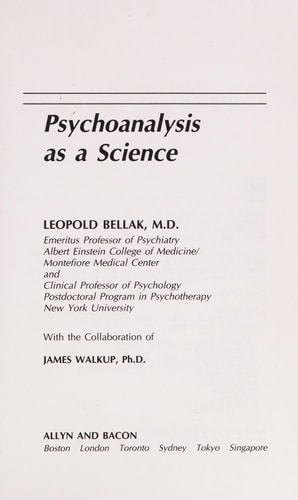
Psychoanalysis as a Science
0
0
As an Amazon Associate and affiliate partner, Menrva Books earns from qualifying purchases. Learn more
Author Description
Since he published his first paper in 1940, Leopold Bellak has attempted to bridge the fields of experimental psychology, psychoanalysis, and psychiatry. In this important new book, Dr. Bellak makes a strong case for integrating the valuable insights of psychoanalytic practice with the theoretical and methodological discipline found in rigorous psychological research.Dr. Bellak's career began with psychoanalytic training in pre-World War II Vienna and included personal friendships with many of the leading figures in the psychoanalytic field. At Harvard graduate school he worked with Henry Murray, Gordon Allport, E.G. Boring, and S.S. Stevens; later he pioneered the use of transcripts of psychoanalytic sessions in research. Drawing on this extensive experience, he provides personal insights into the cultural milieu, personal circumstances, and theoretical legacy behind major developments in the field.Like the author's previous works, Psychoanalysis as a Science makes complex ideas clear, concrete, and interesting. Beginning with an analysis of Freud's most important contributions, the book translates sometimes arcane psychoanalytic propositions into concepts that academic and clinical psychologists, as well as informed lay people, can relate to.Perhaps for the first time in a book of this type, Dr. Bellak succeeds in providing logical, coherent links between psychoanalytic interpretation and currently accepted psychological theory. "Psychoanalysts are simply not aware of many of the implicit assumptions they make," he points out in Chapter 2, adding that they are also not aware that many of these assumptions relate to long-established "laws" of academic psychology.In separate chapters he then goes on to present psychoanalysis as a theory of learning, as a theory of motivation, as a theory of perception, and as developmental theory. He summarizes the long-running conflict between philosophy and psychoanalysis. And finally, he details some of the more interesting oppor
Menrva's Summary
THE THESIS
Can the intuitive insights of psychoanalytic practice be reconciled with the rigorous methodological standards of experimental psychology? Dr. Leopold Bellak, drawing on his extensive background in both pre-war Viennese psychoanalysis and American academic psychology, argues that psychoanalytic theory is not inherently incompatible with scientific discipline. He posits that many psychoanalytic concepts can be translated into the established laws of learning, motivation, and perception, thereby bridging the divide between clinical practice and empirical research.
THE SCOPE MAP
What You Will Find
- A critical re-evaluation of Freudian contributions through the lens of modern psychological theory.
- A framework for interpreting psychoanalysis as a formal theory of learning, motivation, and perception.
- Historical context regarding the development of psychoanalytic thought and its intersection with academic psychology.
- Methodological strategies for integrating clinical transcripts into empirical research models.
THE AUTHORITY PERSPECTIVE
This work is regarded as a significant effort to modernize psychoanalytic discourse by grounding it in the language of academic psychology. The text serves as a bridge for clinicians and researchers seeking to validate psychoanalytic propositions through established scientific inquiry.
Page Count:
208
Publication Date:
1992-04-23
Publisher:
Allyn & Bacon
ISBN-10:
0205139043
ISBN-13:
9780205139040
Science
Psychology
Academic
Psychoanalysis
Psychiatry
Community Tags
Similar Books