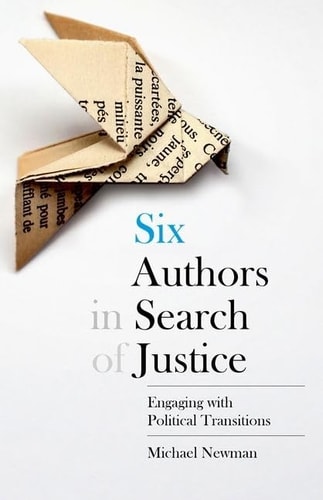
Six Authors in Search of Justice: Engaging with Political Transitions
0
0
As an Amazon Associate and affiliate partner, Menrva Books earns from qualifying purchases. Learn more
Author Description
This book makes an original and readable contribution to defining the nature of justice in the aftermath of a repressive regime. While considering transitional justice as conventionally defined, this work explores broader conceptions of justice and is distinct in approaching the subject through a discussion of the lives and works of six writers: Victor Serge in Stalinist Russia, Albert Camus in Vichy France, Jorge Semprun in Spain under Franco, Ngugi wa Thiong'o in colonial and post-colonial Kenya, Ariel Dorfman in Chile under Pinochet, and Nadine Gordimer in apartheid South Africa. Each lived under a brutal regime, was prepared to take substantial risks in order to contribute to its overthrow, and survived a transition to a new regime. Each thought deeply about the evolving situation with viewpoints derived from a combination of lived experience and intellectual and artistic creation. Each illuminated key questions with reference to a particular country, while developing wider insights.Newman demonstrates that their writings provide a valuable addition to academic analysis and external policy advice that too often fails to take sufficient account of reflective understanding, social and cultural context and the specificity of each situation. He also highlights the evolving and multi-dimensional nature of justice and injustice in political transitions.
Menrva's Summary
THE THESIS
This book investigates how the lived experiences and literary works of six specific authors provide a nuanced understanding of justice during political transitions from repressive regimes. Michael Z. Newman, drawing on his background in political analysis, argues that traditional academic and policy-oriented approaches to transitional justice often overlook the reflective, cultural, and social insights offered by writers who lived through these periods. By examining the intersection of intellectual creation and political upheaval, the author presents a framework that prioritizes individual narrative and context over abstract institutional theory.
THE SCOPE MAP
What You Will Find
- Comparative analysis of six writers: Victor Serge, Albert Camus, Jorge Semprun, Ngugi wa Thiong'o, Ariel Dorfman, and Nadine Gordimer.
- Examination of political transitions in Stalinist Russia, Vichy France, Francoist Spain, colonial Kenya, Pinochet's Chile, and apartheid South Africa.
- A multi-dimensional framework for evaluating justice and injustice in post-repressive societies.
Scope Limits
- The analysis is restricted to the perspectives of these six specific authors and their respective national contexts.
- The book does not provide a comprehensive legal or institutional manual for international transitional justice policy.
THE AUTHORITY PERSPECTIVE
Experts highlight this work as a valuable interdisciplinary bridge between political science and literary studies. Readers frequently note that the prose remains accessible while providing a sophisticated critique of how policy-driven models often fail to capture the complexity of human experience in transition.
Page Count:
328
Publication Date:
2016-10-01
Publisher:
Oxford University Press
ISBN-10:
019049574X
ISBN-13:
9780190495749
History
Biography
Literary Criticism
Transitional Justice
Human rights
Community Tags
Similar Books