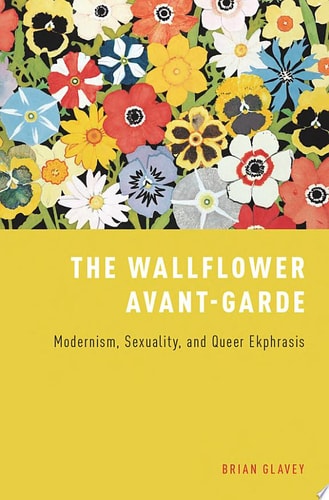
The Wallflower Avant-Garde: Modernism, Sexuality, and Queer Ekphrasis
0
0
As an Amazon Associate and affiliate partner, Menrva Books earns from qualifying purchases. Learn more
Author Description
The Wallflower Avant-Garde highlights a strain of formalism visible in both modernist literature and contemporary queer studies, drawing attention to an aesthetic that is as quiet and quirky as it is queer. In studies of Gertrude Stein, Djuna Barnes, Richard Bruce Nugent, Frank O'Hara, and John Ashbery, Brian Glavey argues for a recalibrated understanding of the relation between sexuality and the aesthetic, revealing a non-oppositional avant-gardism that opts out of some of the binaristic imperatives that have structured recent debates in queer theory. Refusing to decide between positive and negative affects or to side with either utopian or antisocial ambitions, The Wallflower Avant-Garde explores models of reading and writing about art that remain flexible enough to dig deep even as they gloss the surface.At the heart of this argument is a revaluation of modernist ekphrasis, a mode understood as literature's imitation or description of the visual arts. From the well-wrought urns of the New Critics onward, ekphrasis has figured prominently in the legacy of modernist literary criticism, but a tendency to read its complicated modes of relationality in terms of either autonomy or antagonism has obscured the forms of creative failure and imitation embodied in the desire to confuse poetry for pottery. Attending to mimetic and descriptive strategies without dismissing the aspirations for wholeness and closure that often animate them allows for the recognition that queerness and modernism are intertwined in unexpected and unpredictable ways, revealing new insights into the varieties of abstraction, preterition, and spatial form that stand behind modernism's investment in the aesthetic.
Menrva's Summary
THE THESIS
This book investigates how a specific strain of modernist formalism, termed the 'wallflower avant-garde,' offers a new framework for understanding the intersection of sexuality and aesthetic practice. Brian Glavey, a scholar of modernist literature, challenges existing binary debates in queer theory by examining how writers like Gertrude Stein and Frank O'Hara engage with visual art. He argues that these authors utilize a 'wallflower' aesthetic—characterized by quiet, quirky, and non-oppositional modes—to navigate the complexities of desire and representation without relying on traditional utopian or antisocial models.
THE SCOPE MAP
What You Will Find
- Analysis of modernist ekphrasis as a mode of relationality between literature and visual arts.
- Close readings of works by Gertrude Stein, Djuna Barnes, Richard Bruce Nugent, Frank O'Hara, and John Ashbery.
- A theoretical framework that balances surface-level description with deep interpretive inquiry.
Scope Limits
- The study does not provide a comprehensive history of all modernist movements.
- It focuses specifically on the intersection of queer identity and formalist aesthetics rather than broader socio-political histories of the era.
THE AUTHORITY PERSPECTIVE
Scholars in the field of modernist studies and queer theory recognize this work as a nuanced intervention into the study of ekphrasis and formalist aesthetics. Readers frequently note the academic density of the prose, which is intended for an audience familiar with contemporary critical theory and literary analysis.
Page Count:
231
Publication Date:
2015-01-01
Publisher:
Oxford University Press
ISBN-10:
0190493267
ISBN-13:
9780190493264
Art History
Modernism aesthetics
English
English & College Success
Gay Studies
Literary Criticism
Modernism
Queer Theory
Community Tags
Similar Books