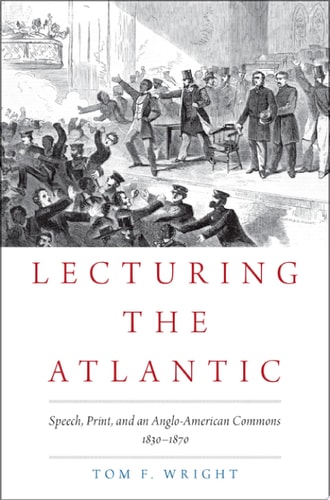
Lecturing the Atlantic: Speech, Print, and an Anglo-American Commons 1830-1870
0
0
As an Amazon Associate and affiliate partner, Menrva Books earns from qualifying purchases. Learn more
Author Description
In the early nineteenth century, the public lecture emerged as one of the Anglo-American world's most important cultural forms. On both sides of the Atlantic, audiences and performers transformed a cultural practice with origins in the medieval cloister into an unexpected flashpoint medium of public life. In the United States, as part of the "lyceum movement," lecturing became crucial to literary and political life, multiple social reform movements, and the rise of public intellectualism, offering speakers from across the cultural spectrum a platform from which to promote their ideas and explain contemporary life.Lecturing the Atlantic argues for a new interpretation of this neglected institution. It reorients our understanding of the lyceum by seeing it as an international and cross-media phenomenon patterned by cultural investment in an "Anglo-American commons." Tom F. Wright shows how some of the mid-century North Atlantic world's most enduring cultural figures, such as Frederick Douglass, William Makepeace Thackeray, and Ralph Waldo Emerson, as well as fascinating marginal voices such as Lola Montez and John B. Gough, used lecture hall discussions of a transatlantic imaginary to offer powerful commentaries on slavery, progress, comedy, order, tradition, and reform. Crucially, this world was a matter as much of print as performance, since as the book reveals, a remarkable culture of newspaper commentary allowed oratory to resonate far beyond the realm of the lecture hall.Through a series of inventive readings of Anglo-American relations as understood through performance and print re-mediation, Wright connects the transatlantic turn in cultural studies to important recent debates in media theory and public sphere scholarship. Lecturing the Atlantic speaks to those interested in the literature and history of Victorian Britain and the early US, to students of performance, communication and rhetoric, and all those seeking a deeper understanding of nineteenth-century
Menrva's Summary
THE THESIS
This book investigates how the public lecture functioned as a vital, cross-media institution that facilitated an Anglo-American cultural commons between 1830 and 1870. Tom F. Wright, a scholar of nineteenth-century literature and culture, utilizes archival research and media theory to argue that the lyceum movement was not merely a local American phenomenon but a transatlantic exchange. By examining the interplay between oral performance and print culture, the author demonstrates how speakers used the lecture platform to shape public discourse on reform, slavery, and national identity.
THE SCOPE MAP
What You Will Find
- Analysis of the lyceum movement as a transatlantic cultural network
- Examination of the symbiotic relationship between live oratory and newspaper reportage
- Case studies of figures including Frederick Douglass, Ralph Waldo Emerson, and William Makepeace Thackeray
- Application of media theory to nineteenth-century rhetorical practices
Scope Limits
- The study is geographically restricted to the North Atlantic region
- The analysis focuses primarily on the period between 1830 and 1870
THE AUTHORITY PERSPECTIVE
Scholars in the fields of Victorian studies and American history recognize this work as a significant contribution to the understanding of nineteenth-century public spheres. Experts frequently highlight the author's ability to bridge the gap between performance studies and print history through rigorous archival analysis.
Page Count:
264
Publication Date:
2017-05-04
Publisher:
Oxford University Press
ISBN-10:
0190496797
ISBN-13:
9780190496791
History
19th Century
Nationalism
Indigenous
United States
Media Studies
Literary Criticism
Nineteenth century
Commons
Communication Studies
Community Tags
Similar Books