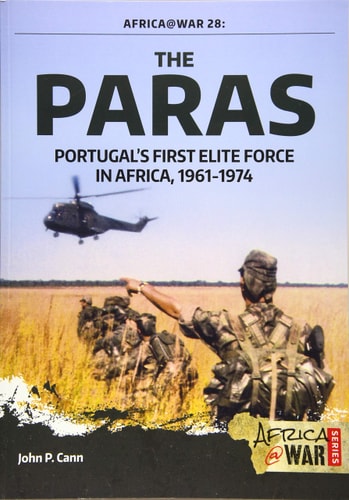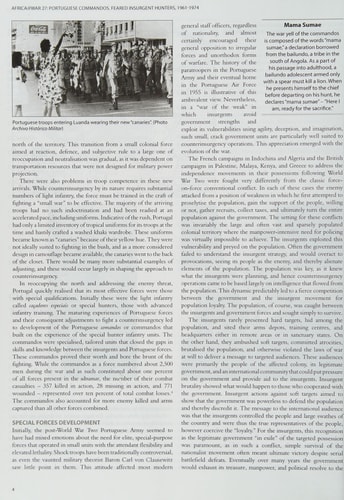
Portuguese Commandos Feared Insurgent Hunters, 1961-1974
0
0
As an Amazon Associate and affiliate partner, Menrva Books earns from qualifying purchases. Learn more
Author Description
During the 13-year insurgency (1961-74) in Portuguese Africa, more than 800,000 men and women served in the Portuguese armed forces. Of this number, about 9,000 served as commandos (or about 1 percent). Yet their combat losses ― 357 dead, 28 missing in action and 771 wounded ― represented 11.5 percent of the total casualties (a percentage 10 times that of normal troops). It is well established that these warriors were responsible for the elimination of more insurgents and capturing more of their weapons than any other force during the war. Great pains were taken to stay abreast of the latest enemy operational methods and maintain the 'warrior edge' in the force. This edge, in essence, was an approach to fighting that pushed the commandos always to think of themselves as the hunter rather than the hunted. Officers returning from contact with the enemy were rigorously debriefed, and commando instructors regularly participated in operations to learn of the latest enemy developments. This information was integrated with intelligence from other sources gathered by the military and national intelligence services, and from this current knowledge, training was constantly revised to remain attuned to the enemy and his behavior. The commandos became a breed apart - and their reputation was such that when insurgents discovered a unit deployed into their area, they would generally withdraw until the killers left. This commando training - and its sympathy with the fighting environment - made the commandos the most effective ground force in the Portuguese Army. The commandos were expert practitioners in the art of counterinsurgency, and their practice of destroying the enemy in great numbers quickly and quietly served as inspiration not only to South Africa and Rhodesia, but to the enemy himself. This is the story of the Portuguese commandos: their beginnings, their unique operations and their legacy and influence in subsequent sister units such as the Buffalo Battalion of South
Menrva's Summary
THE THESIS
This book investigates the effectiveness and unique operational methods of Portuguese Commandos during the 13-year insurgency in Portuguese Africa (1961-1974). John P. Cann, an established author on military history, draws upon extensive military records and operational debriefings to analyze the Portuguese Commandos' role. The book details how their rigorous training, constant adaptation to enemy tactics, and a proactive 'hunter' mentality made them the most effective ground force in the Portuguese Army, responsible for a disproportionately high number of insurgent eliminations and captured weapons.
THE SCOPE MAP
- The origins and development of the Portuguese Commando units.
- Detailed accounts of their unique counterinsurgency operations and tactics.
- Analysis of their combat effectiveness, including casualty statistics and operational successes.
- The psychological impact of the Commandos on insurgent forces.
- The influence of Portuguese Commando doctrine on subsequent military units, including South Africa's Buffalo Battalion.
- The constant revision of training based on real-time intelligence and enemy adaptation.
THE AUTHORITY PERSPECTIVE
This work is recognized for its detailed examination of a specialized military unit's impact during a protracted conflict. The author's focus on operational methods and effectiveness highlights the Commandos' distinct approach to counterinsurgency. The book's analysis of their legacy and influence on other military forces underscores their significant, though often overlooked, contribution to military doctrine. It serves as a valuable resource for understanding the complexities of irregular warfare and the role of elite units within it.
Page Count:
64
Publication Date:
2016-01-01
Publisher:
Helion Limited
ISBN-10:
191109632X
ISBN-13:
9781911096320
Non-Fiction
History
Special Forces
Counterinsurgency
Military History
African history
Community Tags
Similar Books