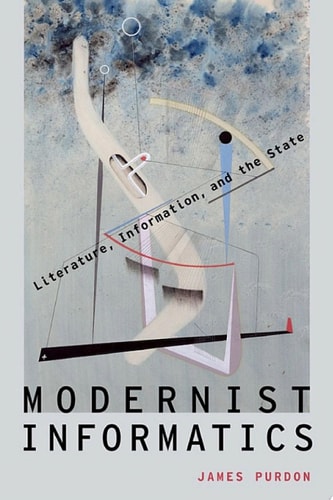
Modernist Informatics: Literature, Information, and the State
0
0
As an Amazon Associate and affiliate partner, Menrva Books earns from qualifying purchases. Learn more
Author Description
Between steam and cybernetics lies a missing phase in the history of information culture. Beginning in the late nineteenth century, national governments and writers of fiction alike began to take an interest in information not simply as fact, nor yet as effortlessly transmissible data, but as an unusual and destabilizing new phenomenon. Modernist Informatics mines this burgeoning bureaucracy and marshals an array of archival evidence to detail the varied reactions of writers struggling in their lives and works to make sense of this strange new age of information. As James Purdon recounts in this fascinating study, many people, including Joseph Conrad and Walter Benjamin, felt the presence of information as an interruption rather than an enhancement of meaningful communication. Its intrusion provoked strong reactions from novelists such as Arnold Bennett, Ford Madox Ford, and Graham Greene. Each regarded the prying eyes of information society with increasing unease, as they struggled to overcome the division of daily existence between a fixed entity on a ledger and the imaginative possibility of everyday life. For others, such as Elizabeth Bowen, the nascent information age offered new opportunities for transforming experience into prose. Relating these varied, complex reactions and how they found their way into fiction, Purdon shows how historical changes shaped the narratives at his study's core and gave birth to a range of new informatic phenomena: passports and identity papers; the dossiers of the Mass-Observation movement; the literal and figurative blackout procedures of the Blitz; and the government-sponsored "information films" of John Grierson. Modernist Informatics ingeniously traces how information culture seeped into everyday lives, forging a relationship of entanglement as well as antagonism-a tension that was central to the shaping of modernity.
Menrva's Summary
THE THESIS
This study investigates how the emergence of modern information systems and bureaucratic surveillance in the late nineteenth and early twentieth centuries fundamentally altered the landscape of literary production and the concept of the individual. James Purdon, a scholar of modernist literature, utilizes archival research and historical analysis to argue that information was perceived by writers not as a neutral tool, but as a disruptive force that challenged traditional modes of communication and identity. By examining the intersection of state-sponsored information management and the creative output of key modernist figures, the book maps the tension between institutional data collection and the subjective experience of daily life.
THE SCOPE MAP
What You Will Find
- Analysis of the transition from Victorian record-keeping to modern cybernetic and bureaucratic information structures.
- Case studies on authors including Joseph Conrad, Walter Benjamin, Arnold Bennett, Ford Madox Ford, Graham Greene, and Elizabeth Bowen.
- Examination of historical informatic phenomena such as identity papers, Mass-Observation dossiers, and wartime information films.
Scope Limits
- The study focuses primarily on British literary modernism and does not provide an exhaustive global history of information technology.
- It does not attempt to provide a technical history of computing or telecommunications, focusing instead on the cultural and literary reception of information.
THE AUTHORITY PERSPECTIVE
Scholars in the field of modernist studies recognize this work as a significant contribution to the understanding of how bureaucratic structures influenced the aesthetic and thematic concerns of twentieth-century literature. Readers frequently note the academic density of the prose, which effectively bridges the gap between historical archival research and literary analysis.
Page Count:
240
Publication Date:
2015-01-01
Publisher:
Oxford University Press
ISBN-10:
0190493321
ISBN-13:
9780190493325
Cultural History
English & College Success
English
Government Information
Literary Criticism
Modernism
Information Studies
British literature
Community Tags
Similar Books