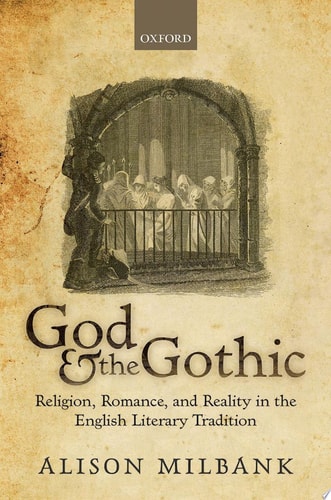
God & The Gothic: Romance and Reality in the English Literary Tradition
0
0
As an Amazon Associate and affiliate partner, Menrva Books earns from qualifying purchases. Learn more
Author Description
God And The Gothic: Romance And Reality In The English Literary Tradition Provides A Complete Reimagining Of The Gothic Literary Canon To Examine Its Engagement With Theological Ideas, Tracing Its Origins To The Apocalyptic Critique Of The Reformation Female Martyrs, And To The Dissolution Of The Monasteries, Now Seen As Usurping Authorities. A Double Gesture Of Repudiation And Regret Is Evident In The Consequent Search For Political, Aesthetic, And Religious Mediation, Which Characterizes The Aftermath Of The Glorious Revolution And Whig Providential Discourse. Part One Interprets Eighteenth-century Gothic Novels In Terms Of This Whig Debate About The True Heir, Culminating In Ann Radcliffe's Melancholic Theology Which Uses Distance And Loss To Enable A New Mediation. Part Two Traces The Origins Of The Doppelgänger In Calvinist Anthropology And Establishes That Its Employment By A Range Of Scottish Writers Offers A Productive Mode Of Subjectivity, Necessary In A Culture Equally Concerned With Historical Continuity. In Part Three, Irish Gothic Is Shown To Be Seeking Ways To Mediate Between Catholic And Protestant Identities Through Models Of Sacrifice And Ecumenism, While In Part Four Nineteenth-century Gothic Is Read As Increasingly Theological, Responding To Materialism By A Project Of Re-enchantment. Ghost Story Writers Assert The Metaphysical Priority Of The Supernatural To Establish The Material World. Arthur Machen And Other Order Of The Golden Dawn Members Explore The Double And Other Gothic Tropes As Modes Of Mystical Ascent, While Raising The Physical To The Spiritual Through Magical Control, And The M. R. James Circle Restore The Sacramental And Psychical Efficacy Of Objects.
Menrva's Summary
THE THESIS
This work investigates the intersection of theological discourse and the Gothic literary tradition, arguing that the genre functions as a complex engagement with religious history and metaphysical inquiry. Alison Milbank, a scholar of literature and theology, utilizes historical analysis and close readings of canonical texts to demonstrate how Gothic tropes serve as vehicles for addressing political, aesthetic, and religious tensions. The book posits that the genre is not merely a pursuit of horror, but a sophisticated project of re-enchantment and mediation in the face of secularization and materialism.
THE SCOPE MAP
What You Will Find
- Analysis of the Reformation, the dissolution of monasteries, and the Glorious Revolution as foundational catalysts for Gothic themes.
- Examination of the Doppelgänger motif within Calvinist anthropology and Scottish literature.
- Interpretations of Irish Gothic as a mechanism for mediating Catholic and Protestant identities.
- Studies of nineteenth-century authors including Ann Radcliffe, Arthur Machen, and M.R. James.
Scope Limits
- The text focuses primarily on the English and British literary tradition, excluding extensive comparative analysis of Continental European Gothic.
- It does not provide a comprehensive survey of contemporary or postmodern Gothic fiction.
THE AUTHORITY PERSPECTIVE
Scholars and critics recognize this text as a significant contribution to the study of the theological dimensions of the Gothic canon. Readers frequently note the academic density of the prose, which requires a foundational understanding of both literary theory and historical theology to fully appreciate the author's arguments.
Page Count:
344
Publication Date:
2018-01-01
Publisher:
Oxford University Press
ISBN-10:
019255784X
ISBN-13:
9780192557841
British literature
Literary Criticism
Theology
Cultural History
Gothic