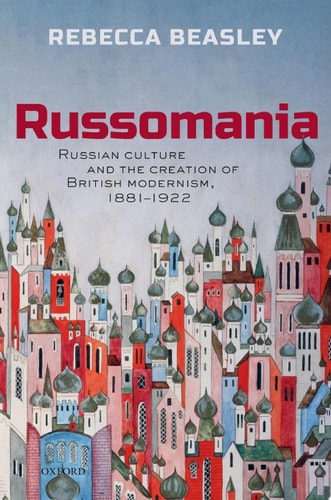
Russomania: Russian Culture and the Creation of British Modernism, 1881-1922
0
0
As an Amazon Associate and affiliate partner, Menrva Books earns from qualifying purchases. Learn more
Author Description
Russomania: Russian Culture and the Creation of British Modernism provides a new account of modernist literature's emergence in Britain. British writers played a central role in the dissemination of Russian literature and culture during the early twentieth century, and their writing was transformed by the encounter. This study restores the thick history of that moment, by analyzing networks of dissemination and reception to recover the role of neglected as well as canonical figures, and institutions as well as individuals. The dominant account of British modernism privileges a Francophile genealogy, but the turn-of-the century debate about the future of British writing was a triangular debate, a debate not only between French and English models, but between French, English, and Russian models. Francophile modernists associated Russian literature, especially the Tolstoyan novel, with an uncritical immersion in 'life' at the expense of a mastery of style, and while individual works might be admired, Russian literature as a whole was represented as a dangerous model for British writing. This supposed danger was closely bound up with the politics of the period, and this book investigates how Russian culture was deployed in the close relationships between writers, editors, and politicians who made up the early twentieth-century intellectual class—the British intelligentsia. Russomania argues that the most significant impact of Russian culture is not to be found in stylistic borrowings between canonical authors, but in the shaping of the major intellectual questions of the period: the relation between language and action, writer and audience, and the work of art and lived experience. The resulting account brings an occluded genealogy of early modernism to the fore, with a different arrangement of protagonists, different critical values, and stronger lines of connection to the realist experiments of the Victorian past, and the anti-formalism and revived romanticism of the
Menrva's Summary
THE THESIS
This book investigates how the reception of Russian culture between 1881 and 1922 fundamentally shaped the development of British modernism. Rebecca Beasley, a scholar of modernist literature, challenges the traditional Francophile-centric view of British literary history. She argues that the intellectual landscape of the era was a triangular dialogue between English, French, and Russian models, where Russian literature served as both a catalyst for stylistic innovation and a perceived political threat to the British intelligentsia.
THE SCOPE MAP
What You Will Find
- Analysis of the dissemination networks for Russian literature in Britain.
- Examination of the intellectual debates regarding the relationship between language, action, and lived experience.
- Historical context on the interplay between writers, editors, and politicians of the early twentieth century.
Scope Limits
- The study focuses specifically on the period between 1881 and 1922.
- It does not provide a comprehensive survey of Russian literature itself, but rather its reception and influence within the British context.
THE AUTHORITY PERSPECTIVE
Scholars recognize this work as a significant intervention in modernist studies for its recovery of neglected figures and institutions. It is frequently cited for its rigorous archival research and its successful reframing of the genealogy of British literary modernism.
Page Count:
549
Publication Date:
2020-01-01
Publisher:
OUP Oxford
ISBN-10:
0192522485
ISBN-13:
9780192522481
History
19th Century
British literature
Russian
Cultural History
English literature
Modernism
Indigenous
Intellectual History
Literary Criticism
Community Tags
Similar Books