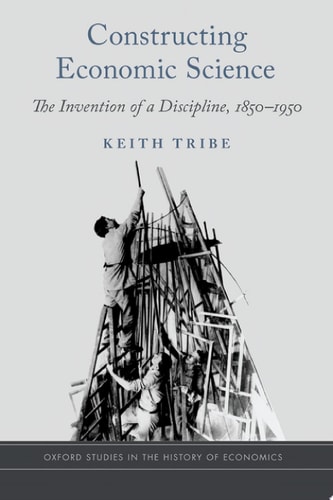
Constructing Economic Science: The Invention of a Discipline 1850-1950
0
0
As an Amazon Associate and affiliate partner, Menrva Books earns from qualifying purchases. Learn more
Author Description
An accessible account of the role of the modern university in the creation of economics During the late nineteenth century concerns about international commercial rivalry were often expressed in terms of national provision for training and education, and the role of universities in such provision. It was in this context that the modern university discipline of economics emerged. The first undergraduate economics program was inaugurated in Cambridge in 1903; but this was merely a starting point. Constructing Economic Science charts the path through commercial education to the discipline of economics and the creation of an economics curriculum that could then be replicated around the world. Rather than describing this transition epistemologically, as a process of theoretical creation, Keith Tribe shows how the new "science" of economics was primarily an institutional creation of the modern university. He demonstrates how finance, student numbers, curricula, teaching, new media, the demands of employment, and more broadly, the international perception that industrializing economies required a technically-skilled workforce, all played their part in shaping economics as we know it today. This study explains the conditions originally shaping the science of economics, providing in turn a foundation for an understanding of the way in which this new language transformed public policy.
Menrva's Summary
THE THESIS
This book investigates the core question of how the modern discipline of economics was constructed as an institutional product of the university system rather than solely as an evolution of economic theory. Keith Tribe, a historian of economics, utilizes archival research and institutional history to argue that the emergence of economics between 1850 and 1950 was driven by commercial rivalry, the need for a technically-skilled workforce, and the structural requirements of university curricula. He shifts the focus from epistemological development to the practical constraints of finance, student enrollment, and professional employment demands.
THE SCOPE MAP
What You Will Find
- Historical analysis of the transition from commercial education to academic economics.
- Examination of the 1903 inauguration of the first undergraduate economics program at Cambridge.
- Discussion of the influence of international commercial rivalry on educational policy.
- Analysis of how institutional factors like curricula and teaching methods shaped the discipline.
Scope Limits
- The text does not provide a comprehensive history of economic theory or mathematical modeling.
- It does not focus on the biographies of individual economists, but rather on the institutional environment.
THE AUTHORITY PERSPECTIVE
Experts in the history of economic thought recognize this work as a significant contribution to understanding the institutional origins of the field. Readers frequently note the academic density of the prose and the author's meticulous attention to the administrative and structural conditions that defined the discipline.
Page Count:
440
Publication Date:
2021-01-01
Publisher:
Oxford University Press
ISBN-10:
0190491760
ISBN-13:
9780190491765
History
Economics
Economics history
Special Topics
Academic History
Macroeconomic Theory
Economic History
Professional Career & Trade
Education - History
Community Tags
Similar Books


![Great ideas in economics ([Great ideas series, no. 5])](https://storage.googleapis.com/menrva_img_storage/covers/9780080070636.jpg)