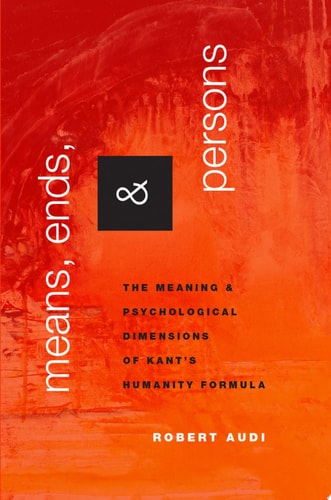
Means, Ends, and Persons: The Meaning and Psychological Dimensions of Kant's Humanity Formula
0
0
As an Amazon Associate and affiliate partner, Menrva Books earns from qualifying purchases. Learn more
Author Description
No one wants to be treated merely as a means-"used," in a sense. But just what is this repugnant treatment? Audi's point of departure is Kant's famous principle that we must treat persons as ends in themselves and never merely as means. Treatment of these kinds is conduct, a complex three-dimensional notion whose central elements are action, its motivation, and the manner of its performance. He shows how the notions of treating persons as ends and, by contrast, merely as means, can be anchored outside Kant and clarified in ways that enhance their usefulness both in ethical theory and in practical ethics, where they have much intuitive force. Audi constructs an account of treatment of persons-of what it is, how it differs from mere interpersonal action, and what ethical standards govern it. In accounting for such treatment, the book develops a wider conception of ethics than is commonly implicit in utilitarian, deontological, or virtue theories. These results contribute to ethical theory, but in its discussion of diverse narrative examples of moral and immoral conduct, the book also contributes to normative ethics. Audi's theory of conduct takes account of motivational elements that are not traits of character and of behavioral elements that are not manifestations of virtue or vice. Here it goes beyond the leading virtue approaches. The theory also advances rule ethics by framing wider conception of moral behavior-roughly, of acting morally. The results advance both normative ethics and ethical theory. For moral philosophy, the book frames conceptions, articulates distinctions, and formulates principles; and for practical ethics, it provides a multitude of cases that illustrate both the scope of moral responsibility and the normative standards for living up to it.
Menrva's Summary
THE THESIS
This book investigates the precise meaning and psychological dimensions of Kant's Humanity Formula, specifically focusing on what it means to treat persons as ends rather than merely as means. Robert Audi, a prominent philosopher, utilizes a framework that integrates action theory, motivation, and performance to clarify these concepts. By moving beyond traditional utilitarian or deontological interpretations, he constructs a comprehensive account of interpersonal conduct that bridges abstract ethical theory with practical moral application.
THE SCOPE MAP
What You Will Find
- A three-dimensional analysis of conduct involving action, motivation, and performance.
- A comparative study of Kantian ethics against utilitarian and virtue-based theories.
- A collection of diverse narrative examples illustrating moral and immoral conduct.
Scope Limits
- The text does not provide a comprehensive history of Kantian scholarship.
- It does not focus on political philosophy or legal applications of the Humanity Formula.
THE AUTHORITY PERSPECTIVE
Experts recognize this work as a significant contribution to normative ethics that successfully bridges the gap between abstract theory and concrete moral behavior. Readers frequently note the analytical rigor of Audi's prose, which provides a structured approach to understanding complex interpersonal obligations.
Page Count:
192
Publication Date:
2015-01-01
Publisher:
Oxford University Press
ISBN-10:
0190493518
ISBN-13:
9780190493516
Philosophy
Non-Fiction
Ethics
Moral Philosophy
Kant
Conduct Of Life
Community Tags
Similar Books