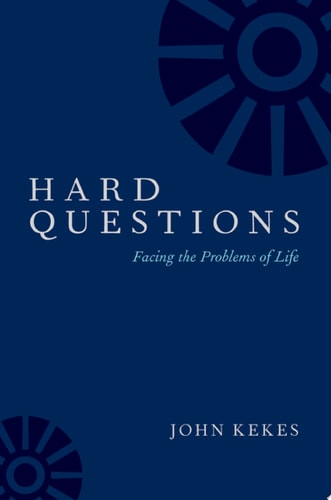
Hard Questions: Facing the Problems of Life
0
0
As an Amazon Associate and affiliate partner, Menrva Books earns from qualifying purchases. Learn more
Author Description
In this book, John Kekes discusses the hard questions we all must face in the course of our lives. Is there an absolute value that overrides all other considerations? Must we conform to prevailing conventions? Do we owe what our country asks of us? Must justice be done at all costs? How should we respond to evil? Should we forgive wrong actions? Does shame make life better or worse? Is it always good to be true to who we are? Do good intentions justify bad actions? Are moral values the highest of all values? There are reasonable answers to these questions, but we find that they often conflict. Their conflicts compel us to weigh the consequences of how the decisions we make affect ourselves, our relationships, and our attitude to the society in which we live. In this clearly and accessibly written book, Kekes compares and evaluates the reasons that have been given for and against answers to these hard questions by those who actually faced them. By learning from the successes and failures of the decisions others have made, we can understand better how we should respond to the hard questions we ourselves face. We can then evaluate more reasonably the possibilities open to us and the limitations to which we are subject. This approach is an alternative to both the absolutist and the relativist ways of trying to answer hard questions. Absolutists have, for millennia, fruitlessly searched for an authoritative answer that reason requires everyone to accept. Their failure have led relativists to assume that there comes a point at which we run out of reasons and have no option but to make an arbitrary decision. Kekes instead offers a message of hope by showing that there are reasonable answers to hard questions, which are neither absolute, nor arbitrary.
Menrva's Summary
THE THESIS
Can individuals navigate life's most difficult moral dilemmas without resorting to either rigid absolutism or arbitrary relativism? John Kekes, a philosopher known for his work on moral pluralism, argues that while there is no single authoritative answer to life's hardest questions, we can arrive at reasonable, non-arbitrary conclusions by examining the historical successes and failures of those who have faced similar conflicts. He posits that moral values often clash, and the path to wisdom lies in weighing the consequences of our decisions within the context of our personal relationships and societal obligations.
THE SCOPE MAP
What You Will Find
- An analysis of specific moral dilemmas including the nature of justice, the response to evil, the role of shame, and the validity of good intentions.
- A comparative evaluation of historical and philosophical arguments regarding moral conflicts.
- A methodological framework for decision-making that prioritizes reason over dogma.
Scope Limits
- The text does not provide a universal set of rules or a definitive moral code for every possible situation.
- It avoids prescribing specific political or religious ideologies, focusing instead on the process of rational deliberation.
THE AUTHORITY PERSPECTIVE
Scholars and readers frequently note the clarity and accessibility of Kekes's prose, which avoids overly technical jargon while maintaining philosophical rigor. Experts highlight this work as a significant contribution to the discourse on moral pluralism, offering a practical alternative to the binary of absolutism and relativism.
Page Count:
320
Publication Date:
2019-01-01
Publisher:
Oxford University Press
ISBN-10:
0190920009
ISBN-13:
9780190920005
Non-Fiction
Religion
Philosophy
Life
Moral Philosophy
Conduct Of Life
Ethics
Community Tags
Similar Books