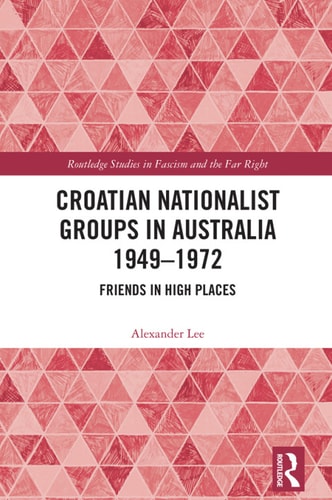
Croatian Nationalist Groups in Australia 1949-1972
0
0
As an Amazon Associate and affiliate partner, Menrva Books earns from qualifying purchases. Learn more
Author Description
Between 1949 and 1972, Australia became the largest centre of violent Croatian nationalism outside of Europe. This book reveals how radical Croatian groups – responsible for bombings, armed incursions, and political violence across two continents – were allowed to proliferate, thanks to the disinterest and tacit support of Australia’s governing Liberal Party. Of all the Eastern and Southern European migrants who arrived in post-war Australia, only Croatians formed groups that Australian Secret Intelligence Organisation (ASIO) considered an actual and continuing danger to domestic security. These communities brought with them a potent blend of nationalist and anti-communist ideology that the Liberal government encouraged, viewing it as electorally useful in the Cold War context. The relationship between the Liberal Party and violent Croatian nationalism became one of the most bitter partisan controversies of the era and had real effects on Australian electoral politics, especially the seminal 1972 election. Drawing primarily on archival research, this book demystifies this controversial period. It examines the real relationship between the Liberal Party, the Labor Party, and violent Croatian nationalist groups. Rather than defending or condemning the actions of the 1949–1972 Liberal-led government or Croatian extremist groups, it provides the first comprehensive historical account of how ideology, partisan politics, and Cold War anxieties allowed this form of violent extremism to take root in Australia. This book will be of interest to researchers in the history of terrorism, nationalism, Australian politics, Croatian politics, and the politics of exile and emigres.
Menrva's Summary
THE THESIS
This book investigates the proliferation of violent Croatian nationalism in Australia between 1949 and 1972 and the political factors that enabled it. The author, Alexander Lee, draws on extensive archival research to examine how radical Croatian groups, responsible for significant political violence, were able to establish a strong presence in Australia. The narrative explores the complex relationship between these groups, the Australian Liberal Party's tacit support driven by Cold War political calculations, and the Australian Secret Intelligence Organisation's (ASIO) concerns. It aims to provide a comprehensive historical account of how ideology, partisan politics, and anxieties of the era fostered violent extremism within migrant communities, with a particular focus on the impact on Australian electoral politics, including the 1972 election.
THE SCOPE MAP
- The historical context of Croatian nationalism in Australia post-WWII.
- Analysis of bombings, armed incursions, and political violence by Croatian groups.
- The role of the Australian Liberal Party and its relationship with nationalist groups.
- The perspective and actions of the Australian Secret Intelligence Organisation (ASIO).
- The influence of Cold War politics and anti-communist ideology.
- The impact of these activities on Australian electoral politics, particularly the 1972 election.
- Examination of the politics of exile and emigre communities.
THE AUTHORITY PERSPECTIVE
The book offers a comprehensive historical account of a controversial period in Australian political history, demystifying the relationship between the Liberal Party, the Labor Party, and violent Croatian nationalist groups. By drawing primarily on archival research, it aims to provide an objective analysis rather than defending or condemning specific actions. The work is positioned to be of significant interest to researchers in the history of terrorism, nationalism, Australian politics, Croatian politics, and the politics of exile and emigres.
Page Count:
0
Publication Date:
2026-02-25
Publisher:
Taylor & Francis
ISBN-10:
1040631320
ISBN-13:
9781040631324
Politics
History
Non-Fiction
Nationalism
Cold War
Australian Politics
Community Tags
Similar Books