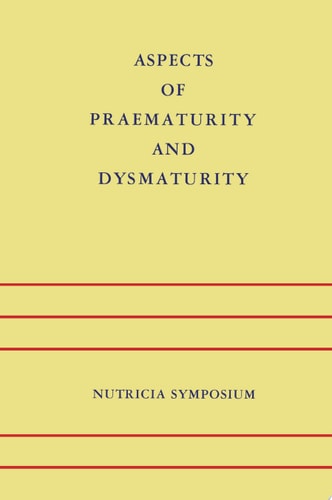
Aspects of Praematurity and Dysmaturity Groningen 10–12 May 1967
0
0
As an Amazon Associate and affiliate partner, Menrva Books earns from qualifying purchases. Learn more
Author Description
The concept of the foeto-placental unit as an integrated endocrine organ has been defined recently by many in vivo studies at the 17th- 20th week of gestation. A functioning foeto-placental unit is necessary for most of the increased oestrogen production of pregnancy and for the provision of glucocorticoids and aldosterone to the foetus. Neither the foetus nor the placenta alone have the necessary enzyme systems for the synthesis of these groups of steroids. However, when the foetus and placenta function as a unit, all of the enzyme systems are present for the synthesis of these steroids from circulating cholesterol. The placenta, but not the mid-gestation foetal adrenal, can synthesize physiologically significant amounts of pregnenolone from circulating cholesterol. Part of the pregnenolone is converted to progesterone in the placenta by the 3~-HSD system (absent in the foetus). The progesterone is transferred to the foetus where it is transformed by C-II, C-17, C-18 and C-21 hydroxylases (all absent in the placenta) to cortisol, corticosterone and aldosterone. Pregnenolone transferred from the placenta to the foetus undergoes 171X-hydroxylation, side chain splitting and sulfurylation (absent in the placenta) and is converted to DHAS. The DHAS may undergo 161X-hydroxylation (absent in the placenta) in the foetal liver and be transported to the placenta as 161X-OH-DHAS. There it is subjected to a neutral steroid sulfatase (absent in the foetus) and is converted to oestriol by action of the 3~-HSD system and the aromatizing enzyme system.
Menrva's Summary
THE THESIS
This collection of papers investigates the complex hormonal interplay between the fetus and placenta during pregnancy. The authors, drawing on research presented at a 1967 symposium, explore the concept of the foeto-placental unit as a singular endocrine organ. They detail the synthesis pathways for crucial steroids like estrogens, glucocorticoids, and aldosterone, highlighting the complementary enzymatic capabilities of the fetus and placenta.
THE SCOPE MAP
- The integrated endocrine function of the foeto-placental unit.
- Steroid synthesis pathways for estrogens, glucocorticoids, and aldosterone.
- The roles of specific enzymes in fetal and placental steroid conversion.
- The transfer and transformation of steroids between mother, fetus, and placenta.
- Discussion of pregnenolone, progesterone, DHAS, and estriol metabolism.
THE AUTHORITY PERSPECTIVE
This volume presents a detailed scientific discussion on the endocrinology of pregnancy, focusing on the collaborative roles of the fetus and placenta. The papers likely offer a foundational understanding of steroid synthesis and metabolism as understood in the late 1960s. The technical nature of the subject matter suggests a readership of medical researchers, endocrinologists, and advanced students in related fields.
Page Count:
368
Publication Date:
2012-12-06
Publisher:
Springer Science & Business Media
ISBN-10:
9401034281
ISBN-13:
9789401034289
Non-Fiction
Science
Medical
Endocrinology
Pregnancy
Community Tags
Other Editions(4)
Similar Books
Reader Comments
Share Your Thoughts
No comments yet. Be the first to share your thoughts!