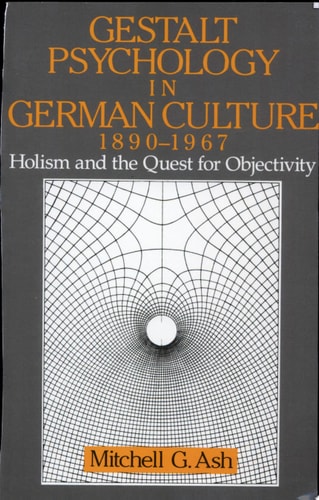
Gestalt Psychology in German Culture, 1890-1967: Holism and the Quest for Objectivity
0
0
As an Amazon Associate and affiliate partner, Menrva Books earns from qualifying purchases. Learn more
Author Description
This is the first full-length historical study of Gestalt psychology--an attempt to advance holistic thought within natural science. Holistic thought is often portrayed as a wooly-minded revolt against reason and modern science, but this is not so. On the basis of rigorous experimental research and scientific argument as well as on philosophical grounds, the Gestalt theorists Max Wertheimer, Wolfgang Köhler and Kurt Koffka opposed conceptions of science and mind that equated knowledge of nature with its effective manipulation and control. Instead, they attempted to establish dynamic principles of inherent, objective order and meaning in current language, principles of self-organization in human perception and thinking, in human and animal behavior, and in the physical world. The impact of their work ranged from cognitive science to theoretical biology and film theory. Based on exhaustive research in primary sources, including archival material cited here for the first time, this study illuminates the multiple social and intellectual contexts of Gestalt theory and analyzes the emergence, development and reception of its conceptual foundations and research programs from 1890 to 1967.
Menrva's Summary
THE THESIS
This study investigates the historical development and cultural impact of Gestalt psychology in Germany from 1890 to 1967. It examines how Gestalt theorists like Wertheimer, Köhler, and Koffka challenged mechanistic views of science and mind, advocating instead for principles of inherent order and self-organization in perception, behavior, and the physical world. The book details the emergence, development, and reception of Gestalt theory, drawing on extensive primary source research to illuminate its complex social and intellectual contexts.
THE SCOPE MAP
- A comprehensive historical account of Gestalt psychology's origins and evolution.
- Analysis of the philosophical and scientific underpinnings of holistic thought.
- Exploration of the work of key figures: Max Wertheimer, Wolfgang Köhler, and Kurt Koffka.
- Examination of Gestalt theory's influence across diverse fields including cognitive science, theoretical biology, and film theory.
- Detailed research based on primary sources and archival material, some cited for the first time.
- An analysis of the social and intellectual contexts shaping Gestalt theory.
- Coverage of the period from 1890 to 1967, tracing the theory's conceptual foundations and research programs.
THE AUTHORITY PERSPECTIVE
This study is recognized as the first full-length historical examination of Gestalt psychology, offering a rigorous account of its development within German culture. It challenges the common perception of holistic thought as anti-rational, instead highlighting the scientific and philosophical basis of Gestalt principles. The book's exhaustive research in primary sources provides a deep understanding of the theory's emergence and its broad impact on various academic disciplines. Its analysis of the conceptual foundations and research programs from 1890 to 1967 makes it a significant contribution to the history of psychology and intellectual history.
Page Count:
528
Publication Date:
1998-10-13
Publisher:
Cambridge University Press
ISBN-10:
0521646278
ISBN-13:
9780521646277
Psychology
Non-Fiction
Philosophy
History
Community Tags
Other Editions(2)
Similar Books














