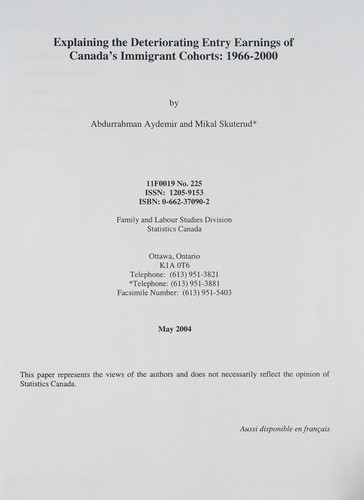
Explaining the Deteriorating Entry Earnings of Canada's Immigrant Cohorts, 1966-2000
0
0
As an Amazon Associate and affiliate partner, Menrva Books earns from qualifying purchases. Learn more
Author Description
This study explores causes of the deterioration in entry earnings of Canadian immigrant cohorts by estimating an empirical specification that nests a number of competing explanations found in the Canadian literature. The study uses the pooled sample of Canadian-born & immigrant men employed full-year, full-time from the complete 20 percent samples of the 1981, 1986, 1991, 1996, and 2001 Censuses. Explanatory factors examined include compositional shifts in the knowledge of an official language, mother tongue, region of origin, foreign education & credentials, and foreign labour market experience.
Menrva's Summary
THE THESIS
This study investigates the decline in initial earnings among immigrants arriving in Canada between 1966 and 2000. The research utilizes comprehensive census data from 1981 to 2001, focusing on full-year, full-time employed Canadian-born and immigrant men. It systematically examines various potential causes, including changes in the composition of immigrants regarding official language proficiency, mother tongue, country of origin, recognition of foreign education and credentials, and prior foreign labor market experience, to explain the observed earnings gap.
THE SCOPE MAP
- Analysis of compositional shifts in immigrant cohorts' official language knowledge.
- Examination of the impact of mother tongue on entry earnings.
- Investigation into regional origin as a factor in earnings disparity.
- Assessment of the role of foreign education and credential recognition.
- Evaluation of foreign labor market experience on initial Canadian earnings.
- Utilization of pooled data from the 1981, 1986, 1991, 1996, and 2001 Canadian Censuses.
- Focus on full-year, full-time employed Canadian-born and immigrant men.
- Nesting of competing explanations for deteriorating entry earnings within an empirical specification.
THE AUTHORITY PERSPECTIVE
This study is a detailed empirical analysis of a significant socio-economic issue in Canada. The research employs robust statistical methods and comprehensive census data to dissect the complex factors influencing immigrant earnings. Its focus on specific explanatory variables provides a granular understanding of the challenges faced by new arrivals. The work is likely to be of interest to economists, sociologists, policymakers, and researchers focused on immigration and labor market integration.
Page Count:
31
Publication Date:
2004-01-01
Publisher:
Statistics Canada
ISBN-10:
0662370902
ISBN-13:
9780662370901
Non-Fiction
History
Economics
Sociology
Community Tags
Similar Books