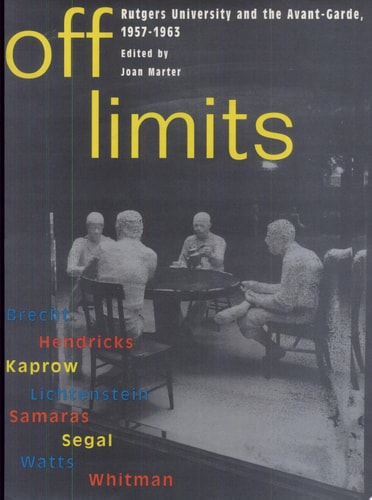
Off Limits: Rutgers University and the Avant-garde, 1957-1963
0
0
As an Amazon Associate and affiliate partner, Menrva Books earns from qualifying purchases. Learn more
Author Description
Off Limits is the first examination of the Rutgers group, artists who came together on the Rutgers University, New Brunswick campus during the 1950s and revolutionized art practices and pedagogy. Based on interviews with artists, critics, and dealers from the period, the book connects the initiation of major trends such as Happenings, Pop Art, and Fluxus to the faculty, students, art curriculum, and events at the university. It is the first book to look not only at the work of individual artists, but to consider how interactions between these artists influenced their groundbreaking work. Rutgers was clearly the place to be for experimental artists during the late 1950s and early 1960s. Allan Kaprow's first Happening was presented at Rutgers. Roy Lichtenstein's first Pop paintings, George Segal's earliest figurative tableaux, Lucas Samaras's radical exploration of media, and proto-Fluxus events by Robert Watts and George Brecht all took place on and around the campus. The innovative group rejected Abstract Expressionism for art based on the immediate experience of urban and industrial life, creating startling new artforms which remain startling and provocative. Led by the theoretical writings and art practice of Kaprow, the group created a New Art--art beyond the limits of the conventional and predictable, even beyond accepted notions of progressive trends. Lichtenstein recalls in an interview, "Kaprow showed us that art didn't have to look like art." Along with Lichtenstein, Kaprow, Segal, and Watts taught at Rutgers and challenged one another to take art "Off Limits" -- beyond the limits of the conventional, the predictable -- even beyond the progressive, as defined by Abstract Expressionist gesturalism. Their art incorporated the gritty environs, the technological, the everyday, making art radical, outrageous, disturbing, and humorous.
Menrva's Summary
THE THESIS
This book examines the pivotal role of a group of artists at Rutgers University between 1957 and 1963 who revolutionized art practices and pedagogy. The book details how this collective, including figures like Allan Kaprow, Roy Lichtenstein, and George Segal, initiated major art movements such as Happenings, Pop Art, and Fluxus, directly influenced by their interactions and the university's experimental art curriculum. It explores their rejection of Abstract Expressionism in favor of art rooted in immediate urban and industrial experience, creating new forms that challenged conventional artistic boundaries. The narrative is built upon interviews with artists, critics, and dealers from the era, providing a rich account of this transformative period in American art.
THE SCOPE MAP
- An examination of the Rutgers group of artists and their impact on art practices and pedagogy.
- Connections between major art trends (Happenings, Pop Art, Fluxus) and the Rutgers University campus environment.
- Insights derived from interviews with artists, critics, and dealers active during the 1950s and 1960s.
- Focus on the interactions between artists and how these influenced their groundbreaking work.
- Case studies of key works and events by Allan Kaprow, Roy Lichtenstein, George Segal, Lucas Samaras, Robert Watts, and George Brecht.
- Analysis of the group's departure from Abstract Expressionism towards art reflecting immediate urban and industrial life.
- Exploration of the concept of art 'Off Limits'—beyond conventional and predictable boundaries.
THE AUTHORITY PERSPECTIVE
This book is regarded as a significant contribution to the understanding of mid-20th-century American art, particularly the development of avant-garde movements. The detailed research, drawing on interviews and contextual analysis, highlights Rutgers University as a crucial incubator for artistic innovation during the period. It is recognized for its thorough exploration of how the interactions among artists and the university's environment fostered the creation of new art forms that challenged established norms. The work is valued for connecting individual artistic breakthroughs to broader artistic and pedagogical shifts.
Page Count:
194
Publication Date:
1999-01-01
Publisher:
Rutgers University Press
ISBN-10:
0813526094
ISBN-13:
9780813526096
Art
Non-Fiction
Modern Art
Art History
American Art
Pop Art
Community Tags
Similar Books