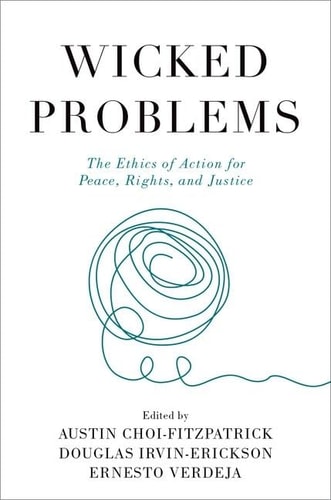
Wicked Problems: The Ethics of Action for Peace, Rights, and Justice
0
0
As an Amazon Associate and affiliate partner, Menrva Books earns from qualifying purchases. Learn more
Author Description
The ethics of changemaking and peacebuilding may appear straightforward: advance dignity, promote well-being, minimize suffering. Sounds simple, right? Actually acting ethically when it really matters is rarely straightforward. If someone engaged in change-oriented work sets out to "do good," how should we prioritize and evaluate whose good counts? And, how ought we act once we have decided whose good counts? Practitioners frequently confront dilemmas where dire situations may demand some form of response, but each of the options may have undesirable consequences of one form or another. Dilemmas are not merely ordinary problems, they are wicked problems: that is to say, they are defined by circumstances that only allow for suboptimal outcomes and are based on profound and sometimes troubling trade-offs.Wicked Problems argues that the field of peacebuilding and conflict transformation needs a stronger and more practical sense of its ethical obligations. For example, it argues against posing false binaries between domestic and international issues and against viewing violence and conflict as equivalents. It holds strategic nonviolence up to critical scrutiny and shows that "do no harm" approaches may in fact do harm.The contributors include scholars, scholar practitioners in the field, and activists on the streets, and the chapters cover the role of violence in conflict; conflict and violence prevention and resolution; humanitarianism; community organizing and racial justice; social movements; human rights advocacy; transitional justice; political reconciliation; and peace education and pedagogy, among other topics. Drawing on the lived experiences and expertise of activists, educators, and researchers, Wicked Problems equips readers to ask--and answer--difficult questions about social change work.
Menrva's Summary
THE THESIS
This work investigates the complex ethical dilemmas inherent in peacebuilding and social change, questioning how practitioners can navigate situations where all available actions result in suboptimal outcomes. The authors, including Austin Choi-Fitzpatrick, Douglas Irvin-Erickson, and Ernesto Verdeja, synthesize perspectives from academic research, field practice, and grassroots activism to challenge conventional wisdom in humanitarian and justice-oriented work. By rejecting false binaries and critically examining established frameworks like 'do no harm,' the text provides a rigorous methodology for evaluating the moral trade-offs required in high-stakes conflict environments.
THE SCOPE MAP
What You Will Find
- Analysis of the role of violence in conflict and strategies for its prevention.
- Critical evaluation of nonviolence, humanitarianism, and transitional justice frameworks.
- Case studies and lived experiences from activists, educators, and field researchers.
- Methodological approaches to navigating ethical trade-offs in community organizing and human rights advocacy.
THE AUTHORITY PERSPECTIVE
Experts and practitioners identify this text as a vital resource for those working in conflict transformation and social advocacy. Readers frequently note the practical utility of the authors' ethical frameworks when applied to the messy, real-world constraints of peacebuilding.
Page Count:
288
Publication Date:
2022-07-15
Publisher:
Oxford University Press
ISBN-10:
0197632823
ISBN-13:
9780197632826
Peace studies
Human rights
Ethics
Social justice
Sociology
Community Tags
Similar Books