Lifting the Chains: The Black Freedom Struggle Since Reconstruction
Author Description
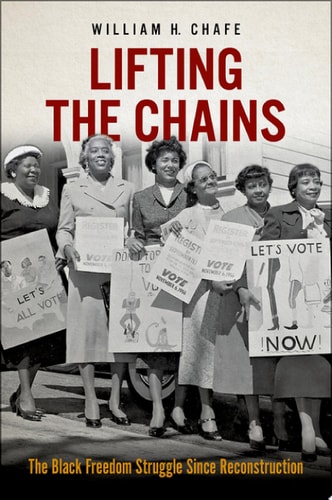
All-Black institutions and local community groups have been at the forefront of the freedom struggle since the beginning.Lifting the Chains is a history of the Black experience in America since the Civil War, told by one of our mostdistinguished historians of modern America, William H. Chafe. He argues that, despite the wishes and arguments of many whites to the contrary, the struggle for freedom has been carried out primarily by Black Americans, with only occasional assistance from whites. Chafe highlights the role of all-black institutions--especially the churches, lodges, local gangs, neighborhood women's groups, and the Black college clubs that gathered at local pool halls--that talked up the issues, examined different courses of action, and then put their lives on the line to make change happen.The book draws heavily on the tremendous oral history archives at Duke that Chafe founded and nurtured, much of which is previously unpublished. The archives are now a collection of more than 3,600 oral histories tracing the evolution of Black activism, managed under the auspices of the Duke Center for Documentary History. The project uncovered the degree to which Blacks never gave up the struggle against racism, even during the height of Jim Crow segregation from 1900 to 1950. Chafe draws on these valuable resources to build this definitive history of African American activism, a history that can and should inform Black Lives Matter and other contemporary social justice movements.
Menrva's Summary
THE THESIS
This work investigates the historical trajectory of the Black freedom struggle in America, arguing that the primary impetus for change has consistently originated from within Black institutions and local community networks rather than external white intervention. William H. Chafe, a distinguished historian of modern America, utilizes extensive oral history archives to challenge traditional narratives regarding the timeline and leadership of the civil rights movement. By focusing on the period from Reconstruction to the present, he demonstrates how Black Americans maintained a continuous, organized resistance against systemic racism even during the most restrictive eras of Jim Crow segregation.
THE SCOPE MAP
What You Will Find
- Analysis of the role of Black institutions including churches, lodges, and local social clubs in political mobilization.
- Utilization of over 3,600 previously unpublished oral histories from the Duke Center for Documentary History.
- Examination of grassroots activism during the Jim Crow era between 1900 and 1950.
- A framework connecting historical civil rights efforts to contemporary social justice movements like Black Lives Matter.
THE AUTHORITY PERSPECTIVE
Experts recognize this text as a significant contribution to the field due to its reliance on primary source oral histories that provide a bottom-up view of American history. Scholars frequently cite the book for its ability to bridge the gap between historical academic research and the context of modern social justice activism.
Page Count:
368
Publication Date:
2023-08-29
Publisher:
Oxford University Press
ISBN-10:
0197616453
ISBN-13:
9780197616451
History
Civil Rights
Social justice
United States
Sociology
Community Tags
Similar Books