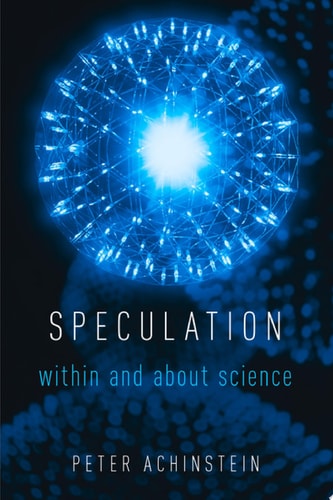
Speculation
0
0
As an Amazon Associate and affiliate partner, Menrva Books earns from qualifying purchases. Learn more
Author Description
Newton Urged Scientists Never To Speculate, Only To Prove By Establishing Experimental Facts. By Contrast, Einstein Urged Scientists To Speculate Freely, Since Only Daring Speculations, Not Experimental Facts, Can Advance Science. Who, If Either, Is Right? Is Speculation A Legitimate Part Of Science, Even In The Absence Of Testing? If So, Can Speculations Be Evaluated Without Testing? How? To Answer These Questions It Must First Be Determined What Counts As A Speculation, A Task Not Usually Investigated By Those Who Express Strong Views About Speculation. In Speculation, Peter Achinstein Develops The Basic Idea That Speculating Involves Introducing Assumptions, Under Certain Theorizing Conditions, Without Knowing That There Is Evidence For Those Assumptions. This Idea Is Made Precise By Utilizing A Concept Of Evidence Achinstein Has Introduced In Previous Writings And Also Explains Here. With This Concept, Achinstein Defends A View According To Which, By Contrast With Newton, Speculations Are Crucial In Science, And By Contrast With Einstein, They Are Subject To Constraints. The Latter Include Pragmatic Ones, Reflecting The Particular Aims Of The Scientist In Speculating, And Epistemic Ones That Are Subject To A Different Standard Then Evidence Sufficient For Belief. This Viewpoint Is Illustrated And Evaluated By Critically Examining Historical And Contemporary Speculations In Fundamental Physics As Well As More General Speculations Within Or About Science, Including These: Nature Is Simple, And Simplicity Is A Sign Of Truth (newton, Einstein); A Theory Can Only Be Tested Holistically (duhem And Quine); And There Is, And Must Be, A Theory Of Everything (string Theorists And Reductionists).
Menrva's Summary
THE THESIS
This book investigates whether scientific speculation is a legitimate practice and how such conjectures can be evaluated in the absence of direct experimental evidence. Peter Achinstein, a philosopher of science, addresses the conflicting methodologies of Newton and Einstein to propose a nuanced framework for scientific theorizing. By defining speculation as the introduction of assumptions without known evidence, the author establishes criteria for evaluating these claims through both pragmatic and epistemic constraints.
THE SCOPE MAP
What You Will Find
- A formal definition of speculation based on specific theorizing conditions.
- An application of Achinstein's previously developed concept of evidence to theoretical physics.
- Critical examinations of historical and contemporary scientific claims, including the principle of simplicity and the pursuit of a Theory of Everything.
Scope Limits
- The analysis does not provide a comprehensive history of all scientific speculation.
- The text does not offer a universal algorithm for validating every possible scientific hypothesis.
THE AUTHORITY PERSPECTIVE
Scholars in the philosophy of science view this work as a significant contribution to the debate over scientific methodology and the limits of empirical verification. Readers frequently note the academic density of the prose, which requires a foundational understanding of both historical physics and philosophical logic to fully appreciate the author's arguments.
Page Count:
192
Publication Date:
2018-01-01
Publisher:
Oxford University Press
ISBN-10:
0190615060
ISBN-13:
9780190615062
Physics
Science History
Epistemology
Philosophy of
Community Tags
Similar Books