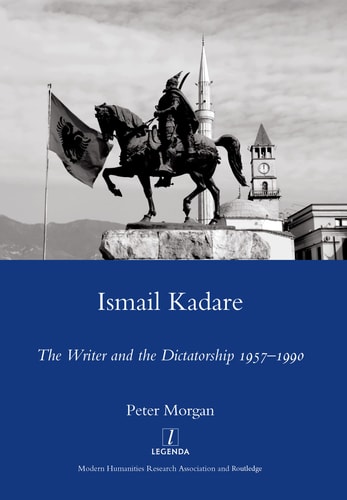
Ismail Kadare The Writer and the Dictatorship, 1957-1990
0
0
As an Amazon Associate and affiliate partner, Menrva Books earns from qualifying purchases. Learn more
Author Description
Ismail Kadare has experienced a life of controversy. In his own country and internationally he has been both acclaimed as a writer and condemned as a lackey of the Albanian socialist dictatorship. Coming of age after occupation and war, Kadare (b. 1936) belonged to the first generation of new Albanians. In a land where writers were routinely imprisoned, Kadare produced the most brilliant and subversive works to emerge from socialist Eastern Europe. His work brings to an end the century whose literary beginnings were marked by the terror to which Kafka gave his name. The inaugural award of the International Man-Booker Prize for Literature in 2005 marked an important milestone in the global recognition of Kadare. Ironic, multi-layered and imaginative, Kadare's writing is profoundly opposed to ideology. Through critical analysis of a representative selection of Kadare's works, Peter Morgan explains for a wide audience how Kadare survived and wrote in the repressive Albanian Stalinist environment.Peter Morgan is Professor of European Studies at the University of Western Australia.
Menrva's Summary
THE THESIS
This book investigates how Ismail Kadare navigated the complex and dangerous political landscape of socialist Albania to produce critically acclaimed and subversive literary works. Peter Morgan, Professor of European Studies, analyzes Kadare's survival and creative output within the repressive Stalinist environment, examining a selection of his works. The study aims to explain Kadare's ability to write profoundly anti-ideological literature while being perceived both as a celebrated author and a collaborator with the dictatorship. It contextualizes Kadare's literary achievements against the backdrop of 20th-century European literature, particularly in relation to the terror evoked by Kafka.
THE SCOPE MAP
- Analysis of Ismail Kadare's literary works produced between 1957 and 1990.
- Exploration of Kadare's controversial international and domestic reception.
- Examination of the political and social context of socialist Albania during Kadare's formative years and writing career.
- Discussion of Kadare's survival strategies as a writer under a totalitarian regime.
- Critical analysis of how Kadare's writing was both brilliant and subversive.
- Contextualization of Kadare's work within the broader landscape of 20th-century European literature.
- Explanation of Kadare's opposition to ideology despite his circumstances.
- Details on Kadare's recognition, including the International Man-Booker Prize in 2005.
THE AUTHORITY PERSPECTIVE
The book offers a critical analysis of Ismail Kadare's literary output and his complex relationship with the Albanian dictatorship, aiming to explain his survival and the subversive nature of his work to a wide audience. It highlights the dual perception of Kadare as both acclaimed writer and perceived lackey, contextualizing his career within the repressive Stalinist environment. The analysis draws on a representative selection of his works to demonstrate how he produced significant literature despite ideological opposition. The book also notes Kadare's international recognition, including the 2005 Man-Booker Prize, as a milestone in his global acclaim.
Page Count:
339
Publication Date:
2010-01-01
Publisher:
Legenda, Modern Humanities Research Association and Maney Pub.
ISBN-10:
1906540519
ISBN-13:
9781906540517
Non-Fiction
History
Biography
Literary Criticism
Community Tags
Similar Books