
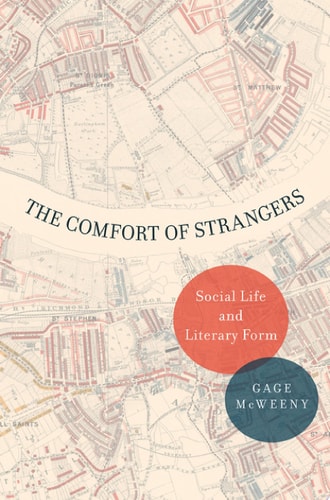
The Comfort of Strangers: Social Life and Literary Form
0
0
As an Amazon Associate and affiliate partner, Menrva Books earns from qualifying purchases. Learn more
Author Description
In most accounts, literature of the nineteenth century compulsively tells the story of the individual and interiority. But amidst the newly dense social landscapes of modernity, with London as the first city of one million inhabitants, this literature also sought to represent those unknown and unmet: strangers. Focusing on the ways that both Victorian literature and modern social thought responded to an emergent "society of strangers," The Comfort of Strangers argues for a new relation between literary form and the socially dense environments of modernity, insisting upon strangers in these works not as alienating, fearsome others, but a relatively banal yet transformative fact of everyday life, the dark matter of the nineteenth-century social universe. Taking up "the literature of social density," Gage McWeeny engages with a range of generically diverse works from the age of Victorian sympathy to illuminate surprising investments in ephemeral relations, anonymity, and social distance. Life amidst strangers on urban streets and markets produced new social experiences, both alluring and fearsome, and McWeeny shows how realist literary form is remade by the relational possibilities offered by the impersonal intimacy of life among those unknown and the power of weak social ties. Reading works by Charles Dickens, Matthew Arnold, George Eliot, Oscar Wilde, and Henry James, he discovers a species of Victorian sociality not imagined under J.S. Mill's description in On Liberty of society as a crowd impinging upon the individual. Instead, McWeeny mines nineteenth-century literature's sociological imagination to reveal a set of works diverted by and into intensities located in strangers and the modern forms of sociality they emblematize. Treating seriously the preference for the many over the few, the impersonal intimacy of strangers over those who are friends and acquaintances, The Comfort of Strangers shows how literature and sociology together produced modern understandings.
Menrva's Summary
THE THESIS
This book investigates how nineteenth-century literature represents the emergence of the 'society of strangers' within the dense urban environments of modernity. Gage McWeeny, an academic specializing in Victorian literature, challenges the traditional focus on individual interiority by examining how authors engaged with the banal yet transformative reality of anonymity. He argues that realist literary forms were fundamentally reshaped by the relational possibilities of impersonal intimacy and weak social ties found in the modern city.
THE SCOPE MAP
What You Will Find
- Analysis of the 'literature of social density' in the nineteenth century.
- Examination of works by Charles Dickens, Matthew Arnold, George Eliot, Oscar Wilde, and Henry James.
- A framework for understanding sociality that prioritizes the impersonal over the intimate.
Scope Limits
- The study does not provide a comprehensive history of urban planning or demographic shifts.
- It does not focus on the psychological development of individual characters in isolation.
THE AUTHORITY PERSPECTIVE
Scholars recognize this work as a significant contribution to the intersection of literary studies and sociology. Readers frequently note the academic density of the prose, which provides a sophisticated re-evaluation of Victorian social dynamics.
Page Count:
239
Publication Date:
2016-01-01
Publisher:
Oxford University Press
ISBN-10:
0190613831
ISBN-13:
9780190613839
History
Victorian
European History
Modernity
Literary Criticism
Cultural History
Sociology
Community Tags
Other Editions(2)
Similar Books









Reader Comments
Share Your Thoughts
No comments yet. Be the first to share your thoughts!