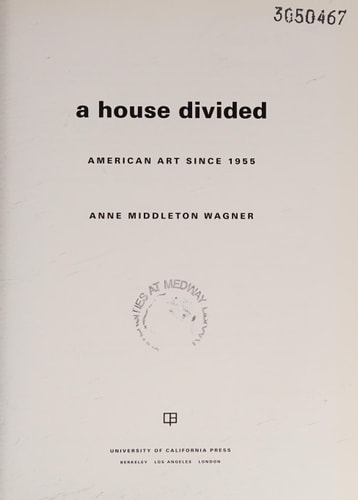
A House Divided: American Art Since 1955
0
0
As an Amazon Associate and affiliate partner, Menrva Books earns from qualifying purchases. Learn more
Author Description
In this exhilarating book, Anne Middleton Wagner challenges readers to rethink the work of a range of post-World War II artists--Jasper Johns, Andy Warhol, Maya Lin, Bruce Nauman, and Agnes Martin among them--and thus to re-assess the relationship of art to politics and social life. The art of U.S. empire, she argues, is marked by deep dividedness. Painters and sculptors seemed entranced by American symbols, yet used them to enigmatic ends--exuberant, nightmarish, or both. Nor could postwar culture decide if it preserved sites devoted to productive withdrawal--for artists, the special zone called the studio--or simply maintained a margin where numbed subjects rehearsed the rites of vanished self-expression. This book charts the to-and-fro in recent American art between acknowledging the facts of nation and consumerism, and searching for meaningful models. And it shows that this process engages--even structures--national history and the citizen's self.
Menrva's Summary
THE THESIS
Anne Middleton Wagner's book investigates the inherent dividedness within American art produced since 1955, exploring its complex relationship with politics and social life. Wagner, a noted art historian, analyzes key post-World War II artists such as Jasper Johns, Andy Warhol, Maya Lin, Bruce Nauman, and Agnes Martin. She argues that the art of the U.S. empire is characterized by a deep internal conflict, where artists engage with American symbols in enigmatic ways, evoking both exuberance and nightmares. The book examines the tension between art's engagement with national identity and consumerism, and the search for meaningful models of expression and critique.
THE SCOPE MAP
- Analysis of prominent American artists from the post-WWII era, including Jasper Johns, Andy Warhol, Maya Lin, Bruce Nauman, and Agnes Martin.
- Exploration of the relationship between American art, politics, and social life.
- Argument that the art of U.S. empire is marked by deep dividedness and internal conflict.
- Examination of how artists use American symbols to enigmatic, often contradictory, ends.
- Discussion of the tension between acknowledging national identity/consumerism and seeking meaningful models for expression.
- Focus on the historical and personal impact of these artistic trends on national history and individual identity.
THE AUTHORITY PERSPECTIVE
This book is regarded as a significant contribution to the study of American art history, offering a challenging re-evaluation of key artists and movements since the mid-20th century. Critics have noted Wagner's insightful analysis of the political and social undercurrents in post-war American art, particularly her argument about the inherent dividedness in works engaging with national symbols. The book is recognized for its intellectual rigor and its ability to connect artistic production to broader cultural and historical contexts. It prompts readers to reconsider the very nature of artistic expression within the framework of American identity and empire.
Page Count:
290
Publication Date:
2012-01-01
Publisher:
University of California Press
ISBN-10:
0520270975
ISBN-13:
9780520270978
Non-Fiction
Art
American Art
Art History
Community Tags
Similar Books