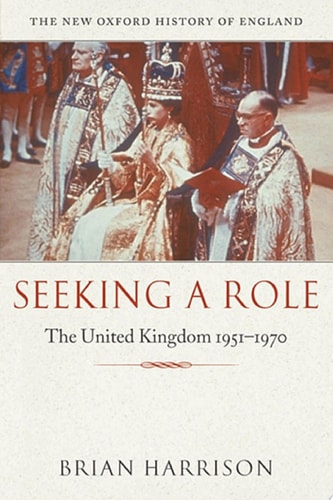
Seeking a Role: The United Kingdom 1951—1970
0
0
As an Amazon Associate and affiliate partner, Menrva Books earns from qualifying purchases. Learn more
Author Description
In this, the first of two self-standing volumes bringing The New Oxford History of England up to the present, Brian Harrison begins in 1951 with much of the empire intact and with Britain enjoying high prestige in Europe. The United Kingdom could still then claim to be a great power, whose welfare state exemplified compromise between Soviet planning and the USA’s free market. When the volume ends in 1970, no such claims carried conviction. The empire had gone, central planning was in trouble, and even the British political system had become controversial. In an unusually wide-ranging, yet impressively detailed volume, Harrison approaches the period from unfamiliar directions. He explains how British politicians in the 1950s and 1960s responded to this transition by pursuing successive roles for Britain: worldwide as champion of freedom, and in Europe as exemplar of parliamentary government, the multi-racial society, and economic planning. His main focus, though, rests not on the politicians but on the decisions the British people made largely for themselves: on their environment, social structure and attitudes, race relations, family patterns, economic framework, and cultural opportunities. By 1970 the consumer society had supplanted postwar austerity, the socialist vision was fading, and 'the sixties' (the theme of his penultimate chapter) had introduced new and even exotic themes and values. Having lost an empire, Britain was still resourcefully seeking a role: it had yet to find it.
Menrva's Summary
THE THESIS
This volume investigates how the United Kingdom navigated its transition from a post-war imperial power to a nation struggling to define its identity between 1951 and 1970. Brian Harrison, a distinguished historian, utilizes a vast array of social and political data to argue that the British people, rather than just their political leaders, were the primary agents of change during this period. He examines the erosion of imperial influence, the decline of central planning, and the emergence of a consumer-driven society to illustrate the nation's search for a new global and domestic role.
THE SCOPE MAP
What You Will Find
- Analysis of the shift from post-war austerity to a consumer-oriented society.
- Examination of social structures, race relations, and family patterns in mid-century Britain.
- Evaluation of the political responses to the loss of empire and the changing status of the welfare state.
Scope Limits
- The text focuses specifically on the years 1951 to 1970 and does not extend into the late 20th-century political shifts.
- The analysis prioritizes domestic social and cultural evolution over detailed military or diplomatic history.
THE AUTHORITY PERSPECTIVE
Historians and scholars frequently cite this work as a comprehensive and authoritative account of mid-century British social transformation. Readers often note the academic density of the prose, which provides a rigorous examination of the era's complex cultural and political shifts.
Page Count:
688
Publication Date:
2009-01-01
Publisher:
OUP Oxford
ISBN-10:
0191606782
ISBN-13:
9780191606786
History
British History
Academic
European History
20th Century
Social History
Political History
Community Tags
Similar Books