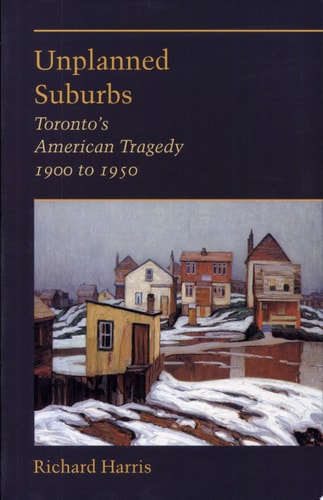
Unplanned Suburbs: Toronto's American Tragedy, 1900 to 1950
0
0
As an Amazon Associate and affiliate partner, Menrva Books earns from qualifying purchases. Learn more
Author Description
It is widely believed that only the growth of mass suburbs after World War II brought suburban living within reach of blue-collar workers, immigrants, and racial minorities. But in this original and intensive study of Toronto, Richard Harris shows that even prewar suburbs were socially and ethnically diverse, with a significant number of lower-income North American families making their homes on the urban fringe. In the United States and Canada, lack of planning set the stage for a uniquely North American tragedy. Unplanned Suburbs serves as a reminder of the dangers of unchecked suburban growth.
Menrva's Summary
THE THESIS
The conventional wisdom that suburban living was only accessible to blue-collar workers, immigrants, and minorities after World War II is challenged by an intensive study of Toronto's prewar development. Richard Harris demonstrates that even before the war, Toronto's suburban fringes were home to a diverse population, including a notable number of lower-income North American families. This unplanned growth, characteristic of a uniquely North American tragedy, highlights the persistent dangers of unchecked suburban expansion and its societal consequences.
THE SCOPE MAP
- Analysis of suburban development in Toronto between 1900 and 1950.
- Examination of the social and ethnic diversity of prewar suburbs.
- Focus on the accessibility of suburban living for lower-income families.
- Critique of the lack of planning in North American suburban growth.
- Discussion of the long-term consequences of unchecked suburban expansion.
THE AUTHORITY PERSPECTIVE
This study challenges the prevailing narrative of post-WWII suburban accessibility by presenting evidence of diverse, lower-income populations in Toronto's prewar suburbs. The work serves as a critical examination of unplanned urban growth and its lasting impact. It is likely to be of interest to scholars of urban planning, history, and sociology, offering a nuanced perspective on the development of North American cities. The book's focus on Toronto provides a specific case study for broader discussions on suburbanization.
Page Count:
356
Publication Date:
1999-10-07
Publisher:
JHU Press
ISBN-10:
0801862825
ISBN-13:
9780801862823
History
Non-Fiction
urban planning
Sociology
Community Tags
Similar Books














