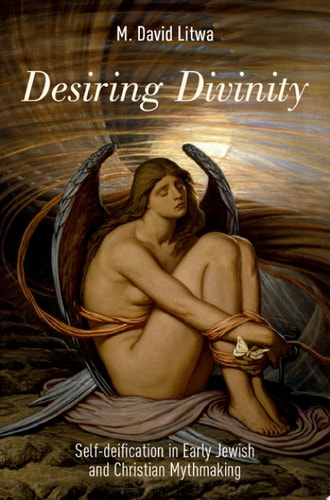
Desiring Divinity: Self-deification in Early Jewish and Christian Mythmaking
0
0
As an Amazon Associate and affiliate partner, Menrva Books earns from qualifying purchases. Learn more
Author Description
Perhaps no declaration incites more theological and moral outrage than a human's claim to be divine. Those who make this claim in ancient Jewish and Christian mythology are typically represented as the most hubristic and dangerous tyrants. Their horrible punishments are predictable and still serve as morality tales in religious communities today. But not all self-deifiers are saddled with pride and fated to fall. Some who claimed divinity stated a simple and direct truth. Though reviled on earth, misunderstood, and even killed, they received vindication and rose to the stars. This book tells the stories of six self-deifiers in their historical, social, and ideological contexts. In the history of interpretation, the initial three figures have been demonized as cosmic rebels: the first human Adam, Lucifer (later identified with Satan), and Yaldabaoth in gnostic mythology. By contrast, the final three have served as positive models for deification and divine favor: Jesus in the gospel of John, Simon of Samaria, and Allogenes in the Nag Hammadi library. In the end, the line separating demonization from deification is dangerously thin, drawn as it is by the unsteady hand of human valuation.
Menrva's Summary
THE THESIS
This book investigates the complex theological and social mechanisms that distinguish between the demonization of self-deifiers and their veneration within early Jewish and Christian traditions. M. David Litwa, a scholar of early Christianity and ancient Mediterranean religions, utilizes a comparative historical framework to analyze how the claim of divinity was interpreted differently depending on the cultural and ideological context of the figure involved. By examining the narratives of six specific individuals, the author argues that the boundary between a hubristic rebel and a divine being is often a subjective construction of religious authority rather than an inherent moral truth.
THE SCOPE MAP
What You Will Find
- Comparative analysis of six figures: Adam, Lucifer, Yaldabaoth, Jesus, Simon of Samaria, and Allogenes.
- Historical and social contextualization of ancient mythmaking regarding human divinity.
- Examination of the Nag Hammadi library and the Gospel of John as primary source material.
Scope Limits
- The study does not provide an exhaustive survey of all self-deification myths in antiquity.
- The analysis focuses primarily on Jewish and Christian traditions, excluding broader Greco-Roman or Eastern parallels.
THE AUTHORITY PERSPECTIVE
Scholars and readers frequently note the academic rigor and nuanced approach Litwa brings to the study of early religious texts. Experts highlight this work as a significant contribution to the understanding of how ancient communities constructed their moral and theological boundaries.
Page Count:
251
Publication Date:
2016-01-01
Publisher:
Oxford University Press
ISBN-10:
0190627433
ISBN-13:
9780190627430
History
Religion
Theology
Early Christianity
Mythology
Judaism
Bibles
Community Tags
Similar Books