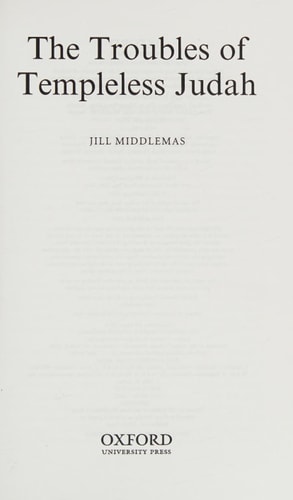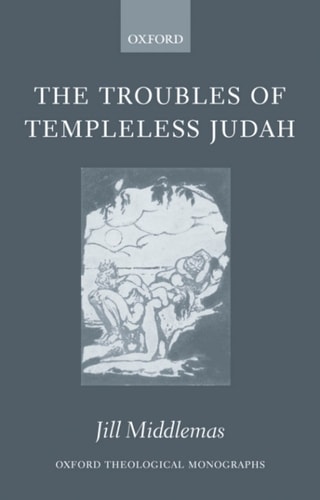
The Troubles of Templeless Judah
0
0
As an Amazon Associate and affiliate partner, Menrva Books earns from qualifying purchases. Learn more
Author Description
The time of the Babylonian capitivity (c.587-539 BCE) is of seminal importance for the formation of the Hebrew Bible as well as for the religious development of Judaism. Previous studies of this era have usually privileged the perspective of the community of captives (the Golah), and the period is known as the `Exilic Age'. Jill Middlemas challenges this consensus, arguing that the Golah community represents only one viewpoint, and that the experiences and contributions of the majority of the Judaean population, those who remained in Judah, need to be more fully appreciated.
Menrva's Summary
THE THESIS
This work investigates the historical and theological significance of the Judaean population that remained in the Levant during the Babylonian captivity, challenging the traditional focus on the exiled Golah community. Jill Middlemas, a scholar in biblical studies, utilizes archaeological data, biblical texts, and socio-historical analysis to reconstruct the religious life of those left behind. She argues that the standard 'Exilic Age' narrative obscures the contributions and experiences of the majority of the population who did not experience deportation to Babylon.
THE SCOPE MAP
What You Will Find
- Analysis of the socio-political landscape of Judah between 587 and 539 BCE
- Examination of religious practices in the absence of the Jerusalem Temple
- Comparative study of biblical texts regarding the 'remnant' versus the 'exiles'
Scope Limits
- Does not provide a comprehensive history of the entire Babylonian Empire
- Does not focus on the internal theological developments of the Golah community in Babylon
THE AUTHORITY PERSPECTIVE
Scholars in the field of biblical studies recognize this monograph as a significant contribution to the revisionist history of the exilic period. Readers frequently note the academic density of the prose and the rigorous methodology applied to often-overlooked archaeological evidence.
Page Count:
306
Publication Date:
2005-01-01
Publisher:
OUP Oxford
ISBN-10:
019153627X
ISBN-13:
9780191536274
History
Religion
Judaism
Near East
Bibles
Theology