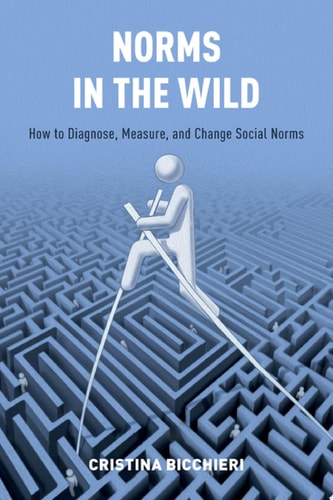
Norms in the Wild: How to Diagnose, Measure, and Change Social Norms
0
0
As an Amazon Associate and affiliate partner, Menrva Books earns from qualifying purchases. Learn more
Author Description
The philosopher Cristina Bicchieri here develops her theory of social norms, most recently explained in her 2006 volume The Grammar of Society. Bicchieri challenges many of the fundamental assumptions of the social sciences. She argues that when it comes to human behavior, social scientists place too much stress on rational deliberation. In fact, many choices occur without much deliberation at all. Bicchieri's theory accounts for these automatic components of behavior, where individuals react automatically to cues--those cues often pointing to the social norms that govern our choices in a social world Bicchieri's work has broad implications not only for understanding human behavior, but for changing it for better outcomes. People have a strong conditional preference for following social norms, but that also means manipulating those norms (and the underlying social expectations) can produce beneficial behavioral changes. Bicchieri's recent work with UNICEF has explored the applicability of her views to issues of human rights and well-being. Is it possible to change social expectations around forced marriage, genital mutilations, and public health practices like vaccinations and sanitation? If so, how? What tools might we use? This short book explores how social norms work, and how changing them--changing preferences, beliefs, and especially social expectations--can potentially improve lives all around the world.
Menrva's Summary
THE THESIS
How can social norms be effectively diagnosed, measured, and modified to improve human welfare and public health outcomes? Cristina Bicchieri, a professor of philosophy and psychology, utilizes her extensive research on behavioral game theory and social expectations to challenge the traditional reliance on rational choice models. She argues that human behavior is frequently driven by automatic responses to social cues rather than deliberate calculation, providing a framework for understanding how these norms are sustained and how they might be altered to address complex social issues.
THE SCOPE MAP
What You Will Find
- A theoretical framework for distinguishing between social norms, conventions, and personal beliefs.
- Methodologies for diagnosing and measuring social expectations within specific communities.
- Practical applications of norm-change strategies in the context of human rights and public health.
Scope Limits
- The text does not provide an exhaustive history of sociological theory.
- It does not offer a universal solution for every cultural context, focusing instead on the mechanics of norm-based behavioral change.
THE AUTHORITY PERSPECTIVE
Experts recognize this work as a vital bridge between abstract philosophical theory and applied development policy. Readers frequently note that the prose is accessible yet rigorous, making it a standard reference for practitioners working in international development and behavioral science.
Page Count:
257
Publication Date:
2016-01-01
Publisher:
Oxford University Press
ISBN-10:
0190622075
ISBN-13:
9780190622077
Psychology
Probability
Mathematics Statistics
Public Policy
Sociology
Social Science
Behavior modification
Business Mathematics
Social Norms
Community Tags
Similar Books