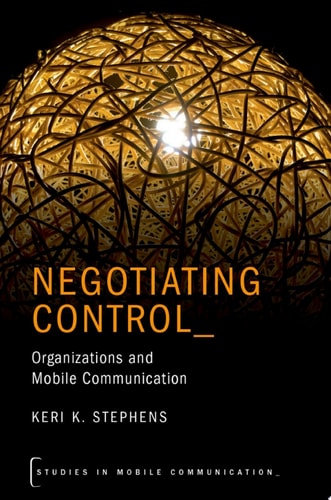
Negotiating Control: Organizations and Mobile Communication
0
0
As an Amazon Associate and affiliate partner, Menrva Books earns from qualifying purchases. Learn more
Author Description
The fast-food worker finds refuge in a bathroom stall to respond to her boyfriend's fifth message in an hour. The human resources manager sees a colleague sending a stream of text messages during a meeting and quickly grabs her mobile to make sure she's also multitasking. These scenarios are common, but unique to the 21st century. Until the early 2000s, workplaces provided most of the computers and portable devices that employees used to perform their jobs and communicate with others. Today, people bring their own mobile devices to work and create new norms for how communication occurs in the workplace. Managers and organizations respond by setting and enforcing new policies that are intended to help them navigate the ever-changing mobile-communication environment.In Negotiating Control: Organizations and Mobile Communication, Keri K. Stephens responds to the struggles of employees, organizations, and even friends and family, as they try to understand new norms for connectedness in the workplace. Drawing on over two decades of her own research and fieldwork,, representing people in over 35 different types of jobs, Stephens claims that though people assume mobile communication is a uniform practice, there are underlying -- and often hidden -- issues of control and power at play, which shape how people are permitted and expected to use mobiles to communicate while working. The accounts Stephens offers reveal the many ways that these portable tools are actually used across work environments today, integrating information, communication, and data, and connecting people in expected and often conflicting ways.
Menrva's Summary
THE THESIS
This book investigates how the integration of personal mobile devices into the workplace alters traditional power dynamics and organizational control. Keri K. Stephens, a scholar specializing in organizational communication, utilizes over two decades of empirical research and fieldwork to analyze these shifts. She argues that mobile communication is not a uniform practice but a complex negotiation of expectations, authority, and social norms that vary significantly across different professional environments.
THE SCOPE MAP
What You Will Find
- Analysis of mobile communication norms across 35 distinct job types.
- Frameworks for understanding the intersection of personal device usage and corporate policy.
- Examination of hidden power structures and control mechanisms in modern workplaces.
Scope Limits
- The text focuses primarily on the organizational and interpersonal communication aspects rather than the technical specifications of mobile hardware.
- It does not provide a universal policy template for all industries, as it emphasizes the variability of workplace culture.
THE AUTHORITY PERSPECTIVE
Scholars and practitioners in the field of organizational communication recognize this work as a significant contribution to understanding the blurring lines between professional and personal spheres. Readers frequently note that the text provides a nuanced, research-backed perspective on the social implications of ubiquitous connectivity in the modern office.
Page Count:
312
Publication Date:
2018-11-08
Publisher:
Oxford University Press
ISBN-10:
0190625511
ISBN-13:
9780190625511
Technology and Society
Sociology
Workplace Studies
Communication Studies