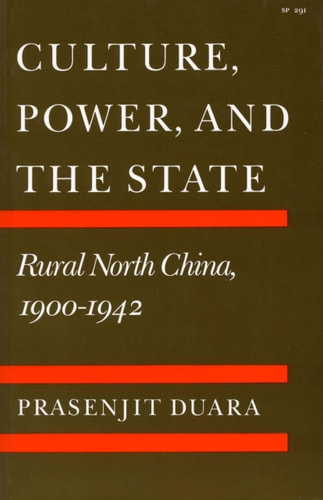
Culture, Power, and the State: Rural North China, 1900-1942
0
0
As an Amazon Associate and affiliate partner, Menrva Books earns from qualifying purchases. Learn more
Author Description
In the early twentieth century, the Chinese state made strenuous efforts to broaden and deepen its authority over rural society. This book is an ambitious attempt to offer both a method and a framework for analyzing Chinese social history in the state-making era. The author constructs a prismatic view of village-level society that shows how marketing, kinship, water control, temple patronage, and other structures of human interaction overlapped to form what he calls the cultural nexus of power in local society. The author's concept of the cultural nexus and his tracing of how it was altered enables us for the first time to grapple with change at the village level in all its complexity. The author asserts that the growth of the state transformed and delegitimized the traditional cultural nexus during the Republican era, particularly in the realm of village leadership and finances. Thus, the expansion of state power was ultimately and paradoxically responsible for the revolution in China as it eroded the foundations of village life, leaving nothing in its place. The problems of state-making in China were different from those of eighteenth- and nineteenth-century Europe; the Chinese experience heralds the process that would become increasingly common in the emergent states of the developing world under the very different circumstances of the twentieth century.
Menrva's Summary
THE THESIS
This book investigates how the Chinese state's efforts to expand its authority in rural North China between 1900 and 1942 reshaped local power structures and social interactions. The author, Prasenjit Duara, a historian specializing in Chinese social history, utilizes a framework he terms the 'cultural nexus of power' to analyze the complex interplay of marketing, kinship, water control, and religious patronage at the village level. He argues that the state's expansion, particularly during the Republican era, fundamentally altered and delegitimized these traditional structures, especially concerning village leadership and finances. This erosion of village life, Duara posits, paradoxically laid the groundwork for the Chinese Revolution and offers a model for understanding state-making in other developing nations.
THE SCOPE MAP
- Analysis of state-making efforts in rural North China from 1900 to 1942.
- Introduction and application of the 'cultural nexus of power' concept.
- Examination of village-level social structures including marketing, kinship, water control, and temple patronage.
- Tracing the transformation and delegitimization of traditional cultural nexuses by state expansion.
- Focus on changes in village leadership and finances during the Republican era.
- Comparison of Chinese state-making with European experiences and its relevance to developing world states.
- Exploration of how the erosion of village foundations contributed to the Chinese Revolution.
THE AUTHORITY PERSPECTIVE
Prasenjit Duara's 'Culture, Power, and the State' is recognized for its innovative methodological framework, particularly the concept of the 'cultural nexus of power,' which provides a nuanced lens for examining Chinese social history during the state-making era. Scholars have noted its ambitious scope in analyzing the complex interactions within rural village societies and how these were impacted by the expanding Chinese state. The book is commended for its detailed tracing of changes in village leadership and finances, offering a complex understanding of the forces that led to the Chinese Revolution. Its comparative approach, contrasting Chinese state-making with European models, also positions it as a significant contribution to the study of emergent states in the developing world.
Page Count:
326
Publication Date:
1991-04-01
Publisher:
Stanford University Press
ISBN-10:
0804718881
ISBN-13:
9780804718882
History
Non-Fiction
Chinese History
State Formation
Cultural History
Social History
Community Tags
Similar Books