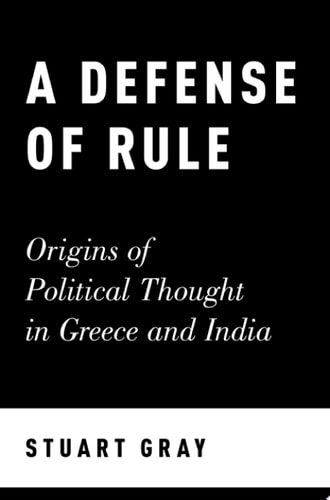
A Defense of Rule: Origins of Political Thought in Greece and India
0
0
As an Amazon Associate and affiliate partner, Menrva Books earns from qualifying purchases. Learn more
Author Description
At its core, politics is all about relations of rule. Accordingly one of the central preoccupations of political theory is what it means for human beings to rule over one another or share in a process of ruling. While political theorists tend to regard rule as a necessary evil, this book aims to explain how rule need not be understood as anathema to political life. Rather, by looking at some of the earliest traditions of political thought we can rethink rule in ways that evoke stewardship rather than domination.Stuart Gray argues that hierarchical ideas about rule coevolved with political divisions between the human and non-human in western theory. The earliest discernible Greek thought advanced an instrumental relationship between humans and their environment, a position that has persisted into our current age. While this seems a defensible position, Gray points out that such instrumental understandings of the nonhuman world have gotten us into serious trouble, including problems of deforestation, global warming, rising sea levels, species loss, and peak oil.To rethink the concept of rule, A Defense of Rule turns to early Indian political thought that suggests that rule is a relationship predicated on stewardship. The book compares these two traditions of thought in order to suggest that we have a normative duty to the environment, and thus to act in a way that takes the interests of non-human nature into account. Basing his argument on his own original translations of primary sources in ancient Greek and Sanskrit, Gray shows when and how early concepts of rule evolved to justify divisions between the human and nonhuman. In doing so, he argues for a reconsideration of our duties toward the nonhuman natural world.
Menrva's Summary
THE THESIS
This book investigates whether the concept of rule can be reimagined as a form of stewardship rather than domination by examining the origins of political thought in ancient Greece and India. Stuart Gray, a scholar of political theory, utilizes his own original translations of primary sources to analyze how hierarchical structures of power emerged alongside human-centric views of the natural world. He argues that the instrumental approach to the environment found in early Greek thought has contributed to contemporary ecological crises, and he proposes that early Indian political traditions offer a more sustainable framework for human-nonhuman relations.
THE SCOPE MAP
What You Will Find
- Comparative analysis of ancient Greek and Sanskrit political texts
- Examination of the coevolution of political hierarchy and environmental exploitation
- Theoretical framework for normative duties toward the nonhuman world
Scope Limits
- The text focuses specifically on early foundational thought rather than modern political systems
- It does not provide a comprehensive history of all ancient political philosophies
THE AUTHORITY PERSPECTIVE
Scholars and readers note that this work provides a rigorous comparative approach to political theory by bridging Western and Eastern intellectual traditions. The text is recognized for its academic depth and its specific focus on the intersection of political power and environmental ethics.
Page Count:
304
Publication Date:
2017-04-03
Publisher:
Oxford University Press
ISBN-10:
0190636319
ISBN-13:
9780190636319
Philosophy
Political Theory
Comparative Politics
Ancient History
Community Tags
Similar Books